Coffee Break Read – The Algorithm

“There has to be a formula.” Dianora glared at her brother. “There has to be an algorithm for writing a bestseller.”
“Ain’t” he grunted stubbornly. “It’s one of them wossnames.”
“Which wossnames precisely?” she placed her words as carefully as blades, but to no avail.
“The wossname that means there ain’t no rhyme nor reason, stupid.”
Dianora seriously considered physically attacking Adamo, but was deterred by the knowledge that he wasn’t a gentleman, was around twice her size, and perfectly capable of attacking her back.  
“So what do we do?”
“You just carry on writing the stuff that pays, and I keep on going to work five days a week. That’s what real life is all about.”
She got up and stomped around the room waving her arms in the air.
“And stop doing that or you’ll hit the wall and bruise your fist.”
Dianora laughed reluctantly. “Okay. I give in. Let’s eat.”

However, the idea of an algorithm had taken root in her head and whenever she had a spare few moments she input as much information as possible slowly, slowly building a picture of what would constitute the ‘perfect’ novel. She added character names, descriptions, traits, and sexuality. She carefully dissected storylines. She even read as much erotica as she could lay her hands on sourcing both terminology and description. Then she just looked at her work for a very long time, unsure if she dare press the combination of keys that would set her brainchild in motion.

It was a wet, cold Friday evening. Adamo was tired and frustrated after a particularly scratchy week, and he came in from work to find his sister clutching a bulky printout. It looked a bit on the thick side for one of the young adult novels that paid the rent, but he took it from her hands and dropped it on his desk.
“Any hurry for this one?”
“No, in your own time.”
He thought Dianora’s voice sounded a bit peculiar, but he was too tired to try and puzzle out the behaviour of someone who was, in his opinion, erratic at the best of times, and downright impossible when in a mood.

It wasn’t, therefore, until Sunday morning that he picked up the typescript and started to read. 
Three hours later he stomped into the kitchen and threw the pages down on the table with a bang.
“That,” he enunciated with careful clarity, “is absolute dross”.
Dianora turned from the pot she had been stirring on the stove and grinned widely.
“It is. But you couldn’t put it down, could you?”
“No. However did you manage to write something so horribly tacky and so completely compelling at the same time?”
“Oh,” she said airily, “I didn’t write it.”
“Well who did?” 
Adamo was getting snappy, which seemed to amuse Dianora greatly. She turned up the cover page and pointed.
‘Darkness of the Soul’ a dystopian love story from the pen of Arabella Churchwarden.
“Yeah, but that’s just your pet name for your computer…”
Then the penny dropped and he stared at her with his mouth agape.
“Yes,” she said proudly. “I wrote the bestseller algorithm.”

©️jj 2019

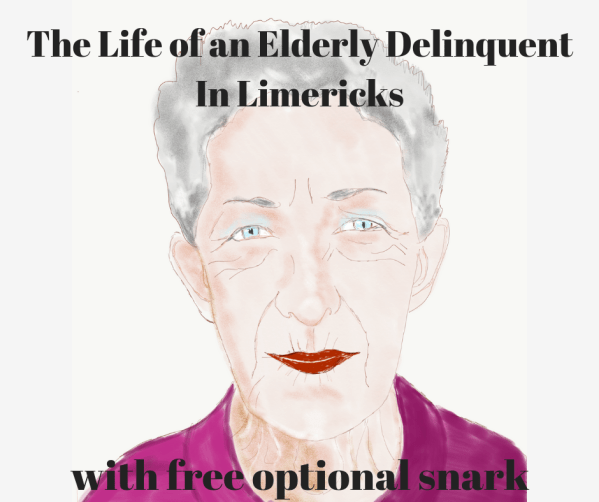
Life in Limericks – Thirty-Five

The life of an elderly delinquent in limericks – with free optional snark…

I am old, and my body attests
To a life full of action and zest
I won’t Botox away
The way I’ve lived my days
And I won’t shave the hairs on my chest

© jane jago

Jane Jago’s Drabbles – Four Hundred and Ten

Gleb looked at the creature on his finger for a long time, amazed and heartened by the warm glowing gold of its tiny body. He knew it didn’t belong down here in the icy depths, and as soon as he had finished looking he would help it back towards the sunlit lands he heard about in his dreams.
Gleb heard Winter stirring, and felt the icy blast of her breath. Smiling gently, he took the fire bee to a place from which it could fly home.
That golden warmth would be something to think about in the cold of everlasting night.

©jane jago

Coffee Break Read – Humans

We had humans here once. When they arrived, they were weak and lost and in need of our help and protection. The trouble was the humans couldn’t commune. They used odd sounds from their mouths to communicate with each other and when any iv’n’bos tried to commune with one, it would clutch its head and scream as if in agony.
Maybe it was. Maybe humans couldn’t commune.
So what to do with them?
In the Dark Season when nothing grew, they would all have died had not some iv’n’bo taken pity and left them food. But the gifts made no difference. The humans simply built an altar to some god and offered thanks there for the food gifts. As if they could not even conceive of the iv’n’bo offering help.
Some said they should be left to starve come the next Dark Season, but that would be against the Plan. The Plan spoke always of compassion for any sentient being and the iv’n’bo all believed and followed the Plan.
But the humans did not.
They had no compassion.
Despite the food gifts being plentiful, despite the bounty of the land and the trees being given freely to feed them if they reached out their hands to take it or stirred themselves to nurture the seeds in the soil. Despite all that, they armed themselves and went out slaughtering sentient creatures, laying them on their vile alter and devouring the burned flesh.
Then they forged blades.
They declared war on the iv’n’bo.
They left us no choice.
We had humans here – once.

E.M. Swift-Hook

Coffee Break read – Death Warrant

From the eighth Fortune’s Fools book Iconoclast: Not To Be by E.M Swift-Hook which is now available for pre-order.

“I know Grim, he wasn’t lying. I also know he’s not a murderer. If he killed, he did so for a reason.”
“Every murderer has a reason,” Durban said gently.
For the first time, he caught a flash of anger in Panvia’s eyes. “Grim,” she repeated firmly, “is a man of principle. He’s got a rep for never using lethal force unless he’s backed into it. Ask anyone. Is not just me saying that ‘cos he’s family. If he killed, it would’ve been because he had no choice. Had no way not to do so.” She fixed Durban with her stare as if willing him to believe her. “You need to understand that.”
Durban nodded. “I hear you loud and clear.”
Standing up, Panvia drained her mug to the dregs then set it on the table. “I hope you do,” she said. “Now I need to go try help Ebon. You know where to find me.”
Rising too, Durban gripped her arm. “Thank you. Thank you for passing the message on.”
“Don’t thank me for it. I nearly didn’t, you know?” She looked sick as she spoke. “I nearly broke my word to my own brother.”
Durban released her arm, suddenly uncertain he had read things correctly. Before he could ask, Gernie spoke across him.
“Tell Ebon we’ve got his back on those repairs, will you?”
Panvia gave him a thumbs up and left the room, closing the door behind her. Durban sank back in his seat again.
“I don’t get..?”
Shaking his head, Gernie took a drink of the cooling mulled wine before he responded. “She loves her brother. Grim gave her a second chance and talked his twin into doing so too. Most of the people in her life before, well, before she wound up here, they didn’t. Even her other sister didn’t and still won’t.”
“I get that. What I don’t get is why that would make her reluctant to pass his message on to me.”
Gernie gave a brief laugh.
“Man! You know for someone who can read people the way most read texts, you can be slow on the uptake sometimes.”
Durban smiled at that. “So what am I missing?”
“Panvia knows you, Durban. She knows what you’ve done, the kind of people you hang out with, what they are capable of. And she knows how good they are at it. Right now, she thinks telling you that message has probably just signed her baby brother’s death warrant.”

E.M Swift-Hook

You can snag your copy of  Iconoclast: Not To Be on preorder now!


Life in Limericks – Thirty-Four

The life of an elderly delinquent in limericks – with free optional snark…

Being old means I’m quite without shame
I can swear, belch and f**t without blame
I can drink till I’m squiffy
Make jokes that are iffy
And call all my neighbours rude names

© jane jago

Author Feature: The Huralon Incident by E.A. Wicklund

The Huralon Incident (Springbok Chronicles Book 1) in the series opener and debut science ficrion novel from E.A. Wicklund

“We’re still running for it?” murmured Zahn as he stood next to McCray.
McCray consulted the tank. “We’re thirty minutes from the heliopause. He can only target us with one of his two lasers while chasing us. We’ll make it into hyperspace before he gets a good hit on us.” 
One of the first things anyone learned about space combat was that the vast majority of laser shots missed. Because of the enormous distances involved, the information on a ship’s location could be many seconds out of date. In that time a ship could have moved thousands of kilometers from the last-known position, and it could be anywhere in a large volume of space. McCray felt that laser fire amounted to a crap shoot—a guess at where the target would be.
“Inbound signal,” said Ando, looking anxious, but then it was his first combat “Liu’s demanding we shut down our paddles and heave to.”
“Tell him to to piss off,” snarled McCray.
“Sir?”
“You heard me.”
Another red blast streaked past on the tactical displays, closer this time.
“Fourteen seconds between shots,” said Warwick. “A fast cycling time, but not for the smaller FireDragon lasers.”
“Copy that, Eyes,” acknowledged McCray. “Liu can shoot all he likes. he’s never going to hit us hard from that range. His laser will attenuate too much to do anything serious.”
“Twenty minutes to the heliopause,” said Zahn. 
“We’re slipping away,” said Warwick, and McCray glanced her way as her fingers dancing across her screens. She looked tense—lines forming on her otherwise smooth features—yet still focused on the job. “He’s five light-seconds behind and we’re opening the range.”
“You see, people?” McCray was grinning. Many of them had never seen combat before. They needed to know he had the situation well in hand. “We’re too fast. He’ll never catch us.” 
The ship shuddered suddenly. Red lights flared across their displays. DC1 Xiang,  the tall, pale-skinned damage control specialist suddenly appeared beside Warwick.
“Hit on Number Two Hyperengine,” Xiang reported “About sixty tons of armor blown off. Cosmetic damage only.”
“A lucky shot,” grated McCray. 
“Standby,” said Xiang, looking worried. “More data coming in. Critical hits on the hyper control runs. Secondaries are down too.” She looked up, the shock plain on her face. “Captain, we cannot enter hyperspace!”
“That’s not possible,” growled McCray, feeling the same shock. He gestured in the air and a screen opened with the harried face of Chief Engineer, Commander Guillermo Parsamayan. “Gui, what the hell happened?”
Gui looked frustrated. “A one-in-a-million shot, sir. Shrapnel from the strike slipped through a gap in the armor and hit both the hyperdrive control runs. This is supposed to be impossible.”
“How long to fix it?”
“I need a couple days at least.”
McCray felt his face sag. “Two days? You gotta be joking.”
Gui shook his head. “No way around it, sir. I got the nanoprinters making parts now, but hypercontrol junctions are complicated pieces of kit. Hyper capability is down for now.”
“Keep me informed, Commander.” McCray ground his teeth in frustration. How could a piddling little pirate do this to his ship and from such a long range? What would those assholes in the admiralty say to this? Whatever the reason, the choices on action had become far simpler now. “Helm! Roll ship and come port to 2-8-5.” 
The maneuver neatly unmasked three of Springbok’s lasers. She had four lasers to the Brazil’s two, but while Brazil could only fire one laser in a stern chase, Springbok’s cleverly designed geometry meant she could return fire with three in the same stern chase. At the helm, Raj replied to his order as McCray turned to Lieutenant-Commander Piper. “Guns, you have a targeting solution?”
Piper grinned ferally. “Locked and ready, sir.”
“Fire!”

A bite of… E.A. Wicklund

Q.01 What do you think drew you to writing Science fiction?

From an early age I studied military history, particularly aircraft during WW2. Technology proceeded at an incredible rate during the conflict. I found myself researching not only the technological developments, but the stories of how pilots used them. What were the advantages/disadvantages of the plane? How did pilots use them to effect or compensate for a flaw? To me, this naturally flows into Science Fiction. No matter what, or how much, technology is in a story, the stories are always about people. So the question becomes: if this story has some incredible technology, how do people use it, and how do they compensate for its flaws? Same questions, really. So progressing into a fascination for science fiction, and science & technology in general, was perfectly rational progression in my view.


Q.02 What were the best and worst things about writing the book?

The best thing was letting my imagination run free. I have written over one thousand pieces of flash fiction, and I love it, but the short form is very restrictive. While writing “The Huralon Incident,” I could suddenly say what I wanted and length (well more so than before anyway). I could finally write about concepts and ideas that had been bouncing around in my head for years, but could never fully express. The worst thing was, “killing your babies.” It’s important to keep the narrative moving at all times and that meant many of the little asides and tangents that I loved had to be removed. My book easily only represents one third or less of all the writing that went into it. It hurts sometimes but then again, no pain, no gain, right? I think the book is better for it.


Q.03 What fast food is your favourite and why?

I love this question! My favorite fast-food, easily findable anywhere in the US, is Arby’s. It’s best with a little pickle and onion and dripping with Arby’s sauce. But here in Austin, the fast food I crave the most comes from Hummus Cuisine. It’s a food trailer. In Austin, some of the most imaginative, progressive food ideas come from food trucks (we’re weird here in Austin and proud of it). Hummus Cuisine is run by a Lebanese couple, and they treat me like family every time I go there. Their gyros plate is absolutely to die for. Their tabouli and hummus is all hand-made and it’s wonderful. There’s no other flavor palette quite like it, and I adore it. Shawarma, which is also available there, even features in The Huralon Incident.

E.A. Wicklund served in the US Navy, as an Operations Specialist aboard several surface warships and is now an IT Consultant living in Austin, Texas with his beautiful wife, Shey, and daughter Hannah. He got hooked on books at a very early age and by twelve had read every Jack London book he could find. His father, a military officer working in Naval Intelligence introduced him to military history books and he swiftly worked his way through the entire collection. When other kids were reading Spiderman comics, he read about the Battle of Leyte Gulf and the greatest naval clash in military history. But when it comes to fiction, Science Fiction is his first love.

You can find him on Goodreads or his humorous flash fiction blog.

Jane Jago’s Drabbles – Four Hundred and Nine

They were Hollywood’s golden couple,  but celluloid affection rarely translates smoothly to real life. It was another celebrity party and both had drunk enough to make a savage fight unavoidable.

Her voice was lightly vicious. “He’s as anonymous as a Souza march, everyone has heard him – they just can’t remember where.”

“And you, my love, are like the common cold. Everyone has had you.”

She leapt on him with bared teeth. As they hit the floor the gunshot was shockingly loud.

He cradled her briefly to his breast before putting that pistol into his own mouth and pulling the trigger.

©jane jago

Sunday Serial – Maybe I

Maybe by Jane Jago and E.M. Swift-Hook . Sometimes we walk the edges of realty…

CHAPTER ONE: JESSICA

           “Well, you know what they say, don’t you pet? What don’t kill you, will make you stronger.”
            Jessica felt her teeth dig into her tongue with the effort of not snapping back. It was one of those glib sayings people trotted out every time they realised there was harm done they couldn’t heal. She wanted to snarl that what didn’t kill you could just as easily leave you broken and bloody, weakened and vulnerable and much less strong than you were before. It could also leave you changed as well as damaged, struggling to know who this stranger was that you had become – the one who jumped at shadows and whose heart started racing when a car engine started up. 
            It was not a good look for a woman who had once been decorated for valour.
            She forced a smile and did not cringe at the hand pat that went with the words of wisdom, delivered from the place of someone whose worst nightmares were about being caught on Scarborough seafront without her make-up on.
            “Your aunt means well, Jess.”
            The voice came from the door of the lounge, which was being pushed open. There was a smell of fresh coffee as Uncle David carried in a tray with a samovar and tiny cups.
            “Oh don’t be so daft, Dave. She knows I mean well, don’t you pet?”
            Jessica nodded and managed a half-smile, then busied herself moving the newspaper, and a couple of magazines about horoscopes and tarot cards, from the table in front of the paisley-patterned settee. Her uncle set the tray down with care then served the coffee as he always did – strong, black and sweet.
            His eyes were not patronising when he looked at her. But then he had fought at Goose Green and brought home his own ghosts to roost in the rafters of the perfect life his wife devised for them both. No children of their own, but then they had Jess.
            “So are you off to Whitby again to see that young man?” Aunt Susan peered over both the top of her cup and her bifocals.
            For a moment, just hearing someone naming the place sent a shiver through Jessica’s spine, and her imagination bridged the miles to place her on top of the cliffs, screaming gulls wheeling overhead, the wind that never slept and Roald, the image of a modern-day viking, hair blowing over his face, shoulders half-hunched in a fleece, face animated, telling her the history of the ruined abbey as if he had been there at the time.

            “It was all started by a woman – Hild. She was an amazing woman and not one you would want to cross. A princess of sorts. And for all she was an abbess eventually, she didn’t decide to become a nun until she was  in her thirties and she’d done one heck of a lot of living by then.” He paused and made a really broad gesture with one arm as if including the ruins and all the headland where they stood. “She loved this place. Would stand up on the cliffs, by the beacon that was here then and look out over the sea, and unbraid her hair so the wind could play with it. And, you know, when she established that first abbey it was nothing like you would think of a monastery today. It was more like a community – both men and women.”
            It was easy to picture Hilda in her Saxon dress, facing out over the waves. Jessica thought of that actress she’d seen playing Rowena in ‘Ivanhoe’.
            “No,” Roald sounded almost angry, “Hild was of Anglic blood – not Saxon. The ones Pope Gregory famously spoke about when he saw some being sold as slaves: ‘Non Angli, sed angeli’.
            Jessica looked at him her mouth very slightly agape. He did that a lot. It was very unsettling.
            “Non angerlee – what?”
            Roald grinned and gave an exaggerated mock wince, as if her pronunciation caused him pain.
            “Non Angli, sed angeli – ‘These are not Angles, they are angels.’ “

Jane Jago and E.M. Swift-Hook

Part 2 of Maybe will be here next week…

Giants

They were the giants, whose shoulders lift us high,
And we, the living, cast our patronising smiles
In weighing deeds of those whose grandeur we decry.
We judge them from the giddy heights of gifted breath,
Belittling those whose words have filled our breast-milk tomes,
So forgetting soon shall we join them in death
And then will others come and rifle through our bones,
To pick the choicest flesh from them – and discard the rest.
Then laugh at all our fears and our misapprehended woes
Themselves to glorify, to think the wisest and the best.

E.M. Swift-Hook

Start a Blog at WordPress.com.

Up ↑