From ‘When Dai met Bryn’

From ‘Dying to be Friends’ by E.M. Swift-Hook and Jane Jago

The Prefect had an office at the top of the Vigiles building with a panoramic view over Londinium. The Augusta Arena, Constantius Column, the Temple of the Divine Diocletian set in beautiful parkland running down to the river, the sub aquila housing, the Forum and the new baths. Dai presumed the Prefect’s view would be even better than the one he had from the small waiting area outside the office. He was on his fourth cup of water from the cooler and wondering if he should risk a quick trip to the snack dispenser he had seen by the lifts to curtail his stomach’s noisy ambition to digest itself, when the door opened and he was shown in to the Prefect’s sanctum.

The Prefect was a stiff-backed old-school Vigiles, clearly not too many years from his – presumably – well-earned retirement back to the warmth and civilisation of Rome. He was standing, not sitting when Dai walked in and responded to his salute with little more than an upwards nod of his head. Dai, standing in his best parade-ground stance, said nothing.

“Llewellyn,” the Prefect was behind his desk and reached down to tap a folder on it – old-school – with the photo of Dai pinned to the front they had taken when he signed up for the course. “Good things. It says very good things.”

There was a pause and the prefect stared at him as if expecting some response.

“Thank you, dominus, I am glad I have been meeting expectations.”

“Meeting. Exceeding. Top of the class, Llewellyn. Highest score we’ve had in years.”

This time Dai said nothing in the silence. They were not told their mark on the Investigator’s exam, only that they had passed it.

“Yes,” the Prefect went on as if answering a question, “Impressive for a Briton. Direct graduate too. Master’s degree. What was that in again?”

“British History,” Dai provided, painfully aware how that sounded every time he said it. “I did do sub-units on the Early Empire and the reign of the Divine Diocletian as well,” he added hurriedly. But for all the reaction he got, he could have said it was Celebrity Studies or Creative Cartwheeling. Dai felt the usual sensation of being invisible, even though on this occasion at least, he was the supposed focus of a Roman’s attention.

“Vacancy here,” the Prefect was saying. “Lost the last man. Tragedy. He was promising too. Very bright. Shame. But have to have someone and you’ll do. Be wasted in the sticks anyway.”

Dai blinked and tried to make sense of what he was hearing. He opened his mouth to ask if he could ask something, but the prefect was speaking again.

“Accommodation provided for the first month, after that on your own – but you’ll be paid by then and can find something in one of the estates.” Then the Prefect stepped away from the desk and glowered at Dai. “I don’t like appointing one of you people, but this role needs it. You will be dealing more with your sort than with Citizens.”

Your sort. The sting of made Dai’s guts tighten.

“I’m not sure I understand, dominus. I am going home tom-”

The Prefect made that odd upward nod, like a wild animal scenting blood.

“No. Not happening. We need you here. Starting now.”

Keep up-to-date with the latest information on the Dai and Julia Mysteries.


Sonnet IV


Sonnet IV

Within the inglenook of creeping night
I steal Calliope’s wings steeped with flame
And an homunculus enters my sight
Bearing aloft a banner with my name.
I stalk to rocky kloofs of distant height
To claim the fabled Phoenix for my own
And by the wounding pens terrible might
I slay the fierce chimaera all alone.
Those Labyrinthine paths conquered by right
So now upon my head Theseus crown
Marks my soliloquy of posey bright
As in Morpheus arms, I softly drown.
From forth my dreams thus comes triumphs of rhyme
For of the Muses choice, I am the prime.

Moonbeam Farquhar Metheringham IV

Sunday Stars ‘In Numina’ with Felix the Fox

This comes at a low point in the case, Felix has broken a leg and is mostly confined to home. He has managed to deactivate some curses (in the form of tabella definiones – curse tablets – but is yet to go after the person who commissioned them. In comes Araxus, his magically talented but mentally unbalanced acquaintance. This is how Felix deals with things, when he gets stuck.

As if to reinforce that point in a grim reminder of my past, the next morning I found Araxus knocking on my door. Bedraggled, stooped, unwashed, unshaven. But his green right eye was looking at me openly, and the mad black one seemingly under his control.

“Do you have a pig?” he asked before I could say anything.

“Ah…”

“Never mind, you will. It’s about the tabellae defixones that we disposed of the other day. Do you still have them?”

“Yes,” I replied. “Why?”

“I wanted to check something.”

My hackles rose. “Do you think they are not inert? I thought we disposed of their magia safely.”

“We did, we did. They are nothing but plumber supplies now. Could I see them, please?”

“Did you think of something new?” I asked, and motioned for him to follow me to my study. I dug out the curse tablets and handed them to Araxus.

He took one from my hand and unfolded it carefully. I looked at him examine the engraved signs. As he read, his green right eye clouded, darkened, became as black as his mad left eye. Clouds drifted past my window, and the room acquired a dark chill.

“Well?” I asked. “What is it?”

He raised his head and looked at me, both eyes black and focused on me, his gaze boring into my soul, my spine shivering and broken ankle suddenly aching more. “It’s as I feared,” he said, voice rasping. “There is more baaa to this than a baaa curse. It’s not a mere supplication to the major baaa gods, it’s almost a love sonnet baaa to invite them to procreate. Do you realise what this baaa means?”

“It means you are insane.”

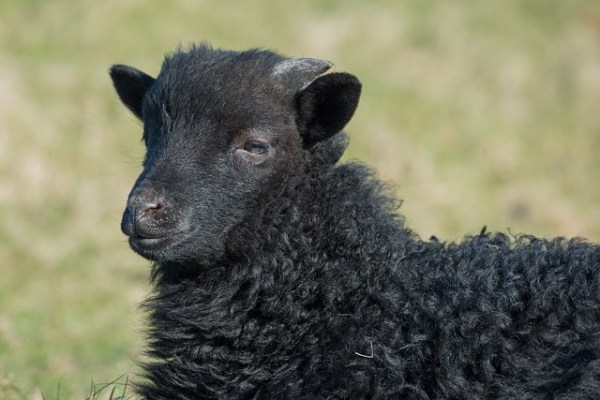
“No! It means that the black sheep has three bags of wool! Baaa!” And with this he broke into a mad little jig, reciting a silly children’s ditty about lambs. After a while I gave up trying to restore his reason, and — somewhat fearful that in his mad state he might reactivate the curse tablets — escorted him out of my house.

I decided I needed some time away from everyone, and that I would not be getting it at home.

My mobility impaired, I could not take on another case. I was in no condition to walk far, but I limped down to the docks between the grain and fish markets, found a good corner, chalked ‘FORTUNES TOLD CURSES IDENTIFIED’ on the wall, sat down on a folding stool, put on airs, and busied myself with a scroll of Assyrican star-gazing that looked impressive with all its strange and foreign symbols.

People being what they are, especially sailors and dock workers, I scraped enough small coins that day to cover a night of drinking. Calculating people’s horoscopes is tedious, but at least cleaner than haruspicy. One sailor wanted me to write a curse against his fellow, whom he swore stole his lucky fascinum when they were asleep. I scribbled a supplication to Hygieia — about as magical as a bucket of piss — to withdraw her protection from the thief’s health. I also sold him a mild laxative in the guise of ‘special medicine’, and told him to slip it in the evening meal whilst at sea to make the guilty party revealed to all. On the off-chance he was wrong about the culprit, the laxative was to go into the main pot, with the supplication into the fire. I taught him a meaningless doggerel to repeat, so I could claim it was his fault for botching it. Thoughts of future winds generated below decks by an overly flatulent crew cheered me up.

In Numina is the sequel to Murder In Absentia: Togas, Daggers, and Magic. If you enjoyed this extract you find some free short stories about Felix on the Egretia website and do check out our interview with the creator of Felix, Assaph Mehr!

A Bite of… Assaph Mehr

We managed to persuade Assaph Mehr, creator of Felix the Fox and the world of Egretia to sit down long enough to answer some questions for us.

Q1: If you could live anywhere in the world, where would it be?

I’d love to be close to classical Europe again. Hope on a train or a short flight, and visit museum, historical sites and what not. It’s probably the one thing I miss most about moving to Australia – it’s just so far away from everything!

That said, I think I’d also love not just where, but WHEN. When I visit ancient sites, heck even when I walk in the “old” streets of Sydney (with building under 150 years old – practically new), I only half pay attention to traffic. The other half of my mind is always seeing things as they once were. I’d love to visit some of those historical places when they were in their prime, see how they really were and how close my imagination filled in the details.


Q2: Which aspects of you are in Felix and why do you feel it is those ones that came through?

There is a lot of me in Felix. Not surprising, really. He’s more gregarious in social situation, though I’d say he’s probably still just a high-functioning introvert. He likes to solve things by himself, by thinking them through (like me), even though he’s very effective in face to face human interactions (unlike me).

He’s a bit of a jack of all trades, master of none. When I used to role-play, most of my characters were that way. Specialisation, as Heinlein once said, is for insects. Just like in my day job and in my author life I tend to pick up broad knowledge and enough skills to get the job done, so does Felix. He never completed his arcane studies, he didn’t stick long in the legions, he learned the art of investigation but went on his own quickly enough. It’s that unique blend of skills – plus his (unlike mine 😉 looser morals – that make him such an effective paranormal trouble solver.


Q3: Who, outside of family and friends, would you most want to read and enjoy your books?

There are authors I admire, some of whose characters influenced Felix. Steven Saylor, author of the Roma Sub Rosa series starring Gordianus the finder, for example. Mr Saylor was very gracious when I sent him an early copy of my novel, and had some encouraging words. Lindsey Davis, author of the Marcus Didius Falco mysteries, on the other hand refuses to read anything by fans of her works.

Ruth Downie, author of the Medicus Roman Mysteries starring Gaius Petreius Russo, was also very supportive. When Felix needed a medic in my upcoming novel, I borrowed Russo – with Ms Downie’s permission!

And there are others, so many others, who’s work influenced me and my writing. Harry Turtledove (the master of alternate histories), Boris Akunin (with his amazing detective Erast Fandorin), Barry Hughart (whose Number Ten Ox is still my favourite historical-fantasy-detective), and many, many others. I’d like to think it’s only a matter of time till I could hold a discussion with them, with turning into an awestruck, blubbering fool.

You can catch up with Assaph on his website, Amazon or Facebook pages and be sure to check out the coffee break read extract from his next Felix adventure that we have right here on the blog!

Your Weekend Wind Down – A Dangerous Hobby


Leisure vehicle users were dying. They were going to sleep in their shiny ‘vans and just not waking up. Various theories were advanced for this phenomenon, including foul play by person or persons unknown, but nobody could actually put their finger on a cause. After some months of speculation. a government-sponsored study was set up. It discovered that people did indeed die in leisure vehicles far more frequently than was statistically explainable – even given the average age of the people concerned.

The findings were, of course, summarily dismissed by leisure vehicle builders as being merely an attempt to frighten customers, and the biggest players in the market banded together in defence of their profitable product.

For a while the buying public was convinced, but a proliferation of news stories about unexplained deaths began to seriously erode consumer confidence and the industry looked as if it would be reporting a drop in profits for the first time in living memory.

This was intolerable, so an emergency meeting of the big boys was convened to look into what could be done to repair the situation.

After a bit of fencing, the industry giants were forced to admit that some sort of a gesture was needed, and it was decided that the players would go away and have a think, reconvening in twenty-eight days with suggestions.

The second meeting was a noisy affair with not a few theories flying around the huge boardroom table. Some advocated an advertising campaign featuring holograms and huge city-centre billboards. Another faction was convinced by special edition models with gorgeous graphics and over-the-top specifications. Both options were considered seriously before being dismissed as being insufficiently impressive.

There was, however, one suggestion that nobody was prepared to entertain for a moment. It was proposed by a group of research and development operatives, who humbly suggested trying to discover whether leisure vehicles might indeed possess some underlying fault that could be responsible for the deaths. The scientist sent to present this unpalatable notion was lucky to escape the convocation with his skin intact, and it was made abundantly clear that such politically unpalatable ideas were not to be entertained.

The unfortunate scientist called his friends to report drawing a blank, and, although nobody was much surprised, there was more than a little disappointment among his peers. A small inner group determined to carry on researching the deaths, while resolving to keep what they were doing under wraps.

Meanwhile the wrangling among the bosses went on for days, with nothing of any substance being decided. In the end another four-week recess was called, and the delegates went away to bully their underlings for some better plans.

While the bullying and chivvying was going on, a very young research assistant beavering away in a design facility in the USA made a disturbing discovery. There was one factor that was common to every ‘van in which unexplained deaths had occurred. Each was fitted with a relatively new and spectacularly efficient battery system, part of which was a wireless control box enabling users to manage all the vehicle functions from their mobile phones. He postulated that there had to be a connection between the system and the fatalities, but the connotations of that were so sinister that nobody was willing to talk about it. The young geek was told to go and find some concrete evidence, and to keep his mouth shut until he did.

While this was going on, the big bosses met for the third time to thrash out an appropriate response to the growing unease. To say the meeting was tetchy is to massively understate the case. The arguments raged back and forth, and men in suits all but came to blows up and down the polished wood of the conference table.

In the end, the Managing Director of the biggest player of all stood up and spoke.
“What we should do,” he said portentously, “is host a worldwide series of long weekend rallies. Rallies with free food, free beer and free entertainment. By this means we will gain much public approval and prove to the doubters that leisure vehicles are absolutely safe.”
He paused for effect.
“We should each host at least one rally. More if we can. We offer free tickets to customers. We invite the world’s press to stay in ‘vans at the rallies. And we ourselves act as hosts of the events, also staying in ‘vans. Does anybody have a better idea?”

Of course nobody did and once the wave of arguments and counter-proposals died down, the job of making arrangements was handed to an army of administrators and gofers.

A paper-thin Latvian gentleman smiled thinly, and made a series of cryptic phone calls once he was in his chauffeur-driven Bentley. The upshot of these calls was a dramatic drop in the trade price of a certain battery system and a corresponding rise in production at a manufacturing plant in northern Germany.

The Latvian met an even thinner man in a private room at a very famous fish restaurant in Barcelona and, over course after course of seafood, into which neither man made much inroads, he reported the upshot of the industry meetings. His host laughed, a short humourless sound, and rubbed his hands together.
“It appears,” he remarked in a colourless and precise voice, “that I may have my vengeance at an earlier date than I could have expected. How did you arrange that?”
“We encouraged a young lady of dubious virtue to drop a suggestion in the ear of a certain gentleman. And he swallowed it.”
“Very good. You have my thanks. The second instalment of your fee will be in your bank tomorrow.”

When the Latvian had bowed himself out of the room the other man picked up his phone and dialled a number. When it was answered he had a quiet-voiced conversation with somebody on the other end. Had there been anyone in the room, they might have noticed the whitening of his knuckles as he held the phone and the single tear that coursed down the side of his rather beaky nose, but he was alone so those rare signs of emotion went unseen. He ended the call and sat for a while regarding his own hands with a grim set to his mouth. Then he spoke coldly and with absolute precision.
“Your little cartel declared war on me and mine all those years ago. Now you are about to pay your debts.”

Then he rose from his seat and left the room, walking very quietly.

High summer in the northern hemisphere saw hundreds of venues prepared to receive visitors. Enormous marquees had been erected, catering companies were roasting pigs and sheep, beers and wines were ready to serve, sound checks had been carried out by expensive musicians, and ‘vans began arriving to be pitched in serried ranks by an armies of smiling marshals in smart uniforms.

At close to the end of the working day on the Friday groups of influential journalists were bused into the each of the various venues. The biggest North American rally was taking place in a huge grassy valley in Utah, and the bus paused on the lip of that valley to permit its passengers a view of the immensity of the undertaking.

A young female news anchor shuddered.
“Look at them,” she pointed at row upon row of all but identical ‘vans pitched with mathematical precision as far as the eye could see. “Will you just look. How does anybody tell them apart? They are fucking clones. Can you imagine being lost among rows and rows of those things?”
A tall Texan grinned.
“Yup. They are mostly indistinguishable. However. According to the press pack, that I seem to be the only one to have read, each ‘van has a homing device accessed via an app on your mobi.”
The girl shuddered again.
“I like that even less. It’s too much like being led along by the nose. And how does anybody know all those things aren’t talking to each other? Talking and plotting. It’s creepy. I’m not staying. Nobody could pay me enough to stay. I’ll walk out if need be.”
The bus driver gave her a thumbs up.
“Just stay on the bus then. I’m dropping off, and heading home. I don’t like this vibe any more than you do.”

The young woman stubbornly stayed on the bus, even in the face of telephone threats from her bosses and increasingly desperate entreaties from representatives of the industry. Something about the setup had her rattled and she wasn’t entirely comfortable until she was on an aeroplane heading home.

Friday evening saw each carefully orchestrated rally swinging into action, and the charm offensive for the world’s media turned up to megawatt intensity. Nobody mentioned the young American anchor, or two Italians, one Frenchwoman, and a Japanese, none of whom could be persuaded to spend any time at all enjoying the hospitality.

As the rally attendees partied, a serious-minded young researcher logged in at a secret facility in Cincinnati. He was convinced there was something wrong with the battery system that now powered more than ninety per cent of leisure vehicles. But he couldn’t for the life of him see what. He should have been at home for his brother’s birthday party, but something inside his head insisted he needed to be in his laboratory. His family excused him and he sat regarding the two examples of the system set up in glass boxes on the laboratory bench.

Something was going to happen, he was sure, he just wasn’t sure he wanted to know what.

Midnight found the last of the music petering out and even the hardiest of ralliers returning to their accommodation. The tall Texan looked at the phone in his hand as it pulled him gently towards his allotted ‘van. He found himself feeling hugely uneasy, and cursed the nervous anchorwoman under his breath. He shrugged his muscular shoulders, unlocked the door of his palatial home on wheels and pulled his soft bag out of the cupboard. Slipping the bag onto his back he rolled up the duvet from the king-sized bed and stuck it under his arm before making his silent way out of the ranks of silver-sided monsters and up the escarpment to a level meadow where he could roll himself in the duvet and sleep under the stars.

Two hours later, in Cincinnati, the researcher was awoken by a message notification, something was talking to his two battery systems. Some elementary instinct for self preservation had him carefully closing the airtight doors on the glass cases before checking his gauges. Nothing. Then he heard the distinctive sound of breaking glass. In each of the systems set up for study a tiny blown-glass vial, which the schematic of the devices said was something to do with self-levelling, had exploded and its contents dripped through a grating into the largest of the batteries. The gauges went wild. It was nerve gas. Powerful nerve gas. The researcher grabbed for his phone, all the while fearing himself to be too late. Two hours later he gave up on trying to contact anybody at any of the rallies. He put his head down on his bench and let the bitter tears fall.

Some hours later in Utah, the Texan awoke with the sun in his eyes, and stretched before sitting up with a rueful grin. It must, he thought, be very early still as there wasn’t a sound in the valley below him. He looked at his watch, then stiffened. That couldn’t be right. It couldn’t be after nine. If it was, the valley would be abuzz with activity. Breakfast was scheduled to start at eight, and by nine there should have been volleyball, tennis, soccer, watercolour painting, and all manner of activities going into on below him. Something was wrong. Badly wrong. He dragged his phone out of his trouser pocket and called for help.

While he waited for the police to arrive he watched the valley, alert for any sign of movement. Of course there was none.

Just shy of fifteen hundred people fell asleep in that valley. None of them ever awoke.

It was the same story all over the world.

Nobody ever moved any of the ‘vans from the venue in Utah and for all we know they are still talking to each other as they quietly rot away where they stand…

© jane jago 2017
The Thinking Quill

Dear Reader Who Writes,

You will recall from our previous acquaintance that I am Moonbeam Farquhar Metheringham IV author of the One Million Bestseller (one million in Amazon Rankings) epic of science fiction and fantasy excellence, ‘Fatswhistle and Buchtooth’. One’s chums tell one that they find the old moniker a bit of a mouthful and for some inexplicable reason few seem able to pronounce it without adding a silent smirk in the middle. Hence, one is usually bespoken of by one’s legions of admirers as ‘Ivy’.

However one is proud of one’s unique and outstanding name. I owe it to my darling Mummie having been a flower-child in her youth and Pater being a frightfully successful stockbroker. Tragically, Pater is no longer with us. He is in a better place, as he assures the world frequently in those Facebook pictures of his suntanned self and the skinny tart he took with him to Barbados.

But enough of my history, you are not here to have your heart bleed for my broken home, you are here to learn from my vast stores of wisdom and humility. I will keep you in anticipation no longer.

How to Start Writing a Book – Lesson 2. The Write Equipment

A delicate pun-ette never goes amiss, gentle Reader Who Writes and brevity in insignificancies is a virtue I profess frequently, so you shall be acronymed into my RWW from now on in this piece.

The importance of beauty cannot be overemphasised. One is a follower of the maxims of the sainted William Morris and will have nothing in one’s bijou writing cave that one does not know to be useful, or believe to be beautiful.

It takes so little effort my beloved RWW to ensure that one writes only on the most perfect sheets of paper, with the most gloriously coloured inks, using pens made from the flight feathers of the Phoenix of one’s imagination.

Oh, would that were true, would that it were.

Instead, we are driven by the exigencies of life in a century that prizes immediacy above the endeavours of gentlemanly artistry. So I have a convenient technological contrivance to enable me to articulate my erudition across the world. From my fingers to your eyes. Miraculous to realise that these words I am typing in my underground retreat shall soon be read by you dear, dear RWW whether you are in Utah or Uzbekistan, Brisbane or Brighton, La Belle France or Lesotho.

So yes, the equipment you most need as a writer is some form of a computer connected to the interwebs. Be sure to have one set up in your chosen writing area (see How to Start Writing a Book – Lesson 1. The Write Environment) before I next grace you with my presence.

And until then, dearly beloved RWW – bon ecrit!

Moonbeam Farquhar Metheringham IV

Your Friday Friend… Brhi Stokes

The Melee

By the time headed back home, the sun was hanging low in the sky and the streets were beginning to come alive.
Too alive, Ripley realised, rounding a corner and then stopping abruptly. A few metres ahead of him, in the centre of the street was a melee. Several creatures with elongated limbs, angular heads and a mottled mix of fur, skin and scales were on the attack. Without the pitch of night to hide their forms, Ripley could clearly see the deformities; the spines and horns and tufts of fur that covered the sinewy muscles of the creatures. Some moved with speed and grace, others in lumbering strides that impacted heavily on the road. Guttural sounds ripped from the group as they lunged and snarled at their opponents.
A gunshot ripped the air and one of the creatures reeled, blood pouring from the side of its face. Once it had gathered itself, it lashed out with a viciously spiked claw sending the shooter sprawling. It leapt, only to find its jaws clamped around the thick of a heavy crowbar as one of the woman’s compatriots dove in with such great strength he was actually able to hold the beast off.
His crowbar snapped, and the creature fell upon the man with claws and teeth. The woman he had saved leapt towards the creature and thrust out a hand. Even from this distance, Ripley could see the sudden melting and hissing that came from where her hand touched its bare flesh. The creature reeled once more, a good chunk of its skin turned a brackish red, steaming.
The two other creatures were under a barrage of gunfire, but they weathered it well. He watched as one of the humanoid men darted out of the way of oncoming teeth and clung like a spider to the wall nearby, sticking even without holding it.
One of the less occupied creatures spun suddenly, its eyes glowing a deep, angry red as it scanned the street. It caught sight of Ripley and, with a growl like nails in a whirling drain, dug its claws into the ground and bounded towards him. Pink saliva bubbled from between its innumerable teeth and a long, snake-like tongue lashed out at him.
Ripley stumbled back, hands reaching down to his pockets in search of any sort of weapon but the creature had sprung.
It reeled suddenly in mid-air as something exploded in front of it, sending liquid and fire splattering across the ground. From the liquid, a sickly green gas rose and the creature began to prowl backwards, snarling and gargling as small bits of fire licked at the tufts of fur across its scaled face.
He did not need to wait for a second chance. Ripley turned and bolted down the nearest alley. Behind him, the sound of sirens was accompanied by the screeching of tires.
His apartment was safe and warm in comparison. He did not leave, and no one came to collect him. A small part of him wondered if he should call someone but he pushed it aside.
He made an informed decision never to go outside again.

From Caligation

For more information see Brhi Stokes Website or buy the book from Amazon.


A bite of… Brhi Stoke’s Ripley

Today we have the opportunity to cross-examine Ripley, hero of Caligation

Question 1: How would you describe your own character? And do you think we would like you if we met?

Describe myself? That’s a hard one, I guess I hadn’t really given it much thought. I suppose I’m fairly… relaxed? I guess that probably translates better to ‘boring’, though. Average guy, average day-to-day, average consumption of beer. The only interesting thing would be that I surf, but everyone here does. Does “wants something more out of life but is too lazy to be something other than complacent” work? As for liking me – I guess so. I think I’m relatively inoffensive, most of the time…. some of the time. I think.

Question 2: If you could have just one thing to help in your quest for survival what would it be, and why?

Some goddamn answers. Actually, then I wouldn’t be on this ‘quest’, which would be ideal. …and back to complacency in boring life I would go. At least this crazy hell-hole is interesting. In all seriousness, though, I would like to have the abilities of some of the other… things here. I think being a monstrous beast would help me out a lot. Or being able to shoot lightning from my fingers or something.

Question 3: In an emergency what is your crutch? Alcohol? Drugs? Blind panic?
Probably blind panic. Having a relatively normal life means I’m not really equipped for crazy stuff. I always thought I was pretty good in a pinch… until I actually got into said pinch and realised that I’m terrible.

Also see Goodreads and Instafreebie.


Enmeshed

She lay at the bottom of the boat, wrapped in a piece of malodorous sacking, neither moving nor making a sound.
“Do she live?” one of the swarthy oarsmen asked of nobody in particular.
The oldest crewman spat into the black water of the harbour. “Course she lives, but she knows what us will do to her if’n she causes a ruckus.”
The youngest lad looked almost pleadingly at their unexpected cargo.
“We isn’t going to hurt her is we?”
“No. We ain’t. But them as we sells her to may not be so considerate.”
“So why we selling her to them?”
“Because we got wives and childer and bellies to fill through winter…”
“And because her folk are bad luck. Now throw some water over that sack. Gotta keep it nice and moist.”

The little boat rounded the mole that marked the end of the harbour and none of the oarsmen had breath to speak more as they fought the swell.
“Back oars,” the steersman yelled and the boat was drawn into the mouth of a cove almost surrounded by dark basalt cliffs.

They waited and it wasn’t long before a boat put out from the tiny black beach. It had a light high on the stern and the fishermen all averted their gaze.

They felt, rather than saw the boat come alongside.
“Do you have trade goods?” the voice was reedy and thin and somehow otherworldly.
“We do sir. Merwoman.”
“Show me.”
The steersman lifted the sacking to expose a slender female figure still entrapped in a coarse rope net
“You set out to catch a daughter of the sea?”
“No sir. We was after codfish.”
There came a breathy woodwindy laugh.
“Very well. The usual fee. Place her in the boat.”
The steersman signalled to the young lad, who lifted the frail figure in his warm arms and carefully placed her on the cushioned bottom of the black boat.
“I’m sorry,” he whispered.

Something heavy landed at the steersman’s feet, and the fishermen bent to their oars as if their lives depended on it.

There was rejoicing in the village that evening, as the gold was shared out and all the families knew they would eat that winter.

The music played and the beer steins were filled and everyone was happy. Or almost everyone….

As autumn turned to winter the fishing boats were pulled up on the shingle and the men began the annual tasks of caulking hulls and mending nets. Nobody really paid much attention to the youngest of the fishermen; he was just a clumsy lad and who was to care if he grew thin and pale and abstracted.

He spent a lot of his free time sitting on a smooth grey rock that jutted out into the sea. The old wives declared him lovesick and cast their eyes on the local girls to see who might be the object of his affection. But none came forward.

The night of the dead came and went, and in the morning the young man’s bed hadn’t been slept in. The old beldame he lodged with was curious enough to go looking for him. When she hadn’t found him by mid morning she began to be worried, so she went to the headman who somewhat grudgingly set up a search.

He was nowhere to be found, and it wasn’t until the tide receded that a group of children digging for shellfish saw the bundle of tangled nets at low water line.

They went to investigate, and the youngest girl spotted a bloated drowned face which seemed to be looking at them from the ropey entanglement.

She swears to this day that as she reached the body one blue eye winked….

© jane jago 2017

Start a Blog at WordPress.com.

Up ↑