Jane Jago’s Daily Drabble – Three Hundred and Sixty-Six

Grandma and Grandpa chose the rug for its bright colours and hooked it sitting by the fireside. It took them a whole winter but they were agreed it looked handsome when done.

It was good wool and it gave them warmth and pleasure. They would sit with their bare toes buried in its thickness and grin at each other happily.

When Grandpa died, Grandma lost interest and just faded away.

House clearance was the province of their sharp-voiced daughter, who was accounted efficient and emotionless. 

People would have laughed to see her crying over a faded and scorched rug… 

©jj 2019

Coffee Break Read – A Desolate Field

From Times of Change the second volume of Transgressor Trilogy, a Fortune’s Fools book by E.M. Swift-Hook. You can listen to this on YouTube.

Nothing was said as they were riding back until a short way from his house, Zarengor reined in sharply, bringing his pony in front of Ralik’s and forcing him to stop.
“Gods, I am sorry Ralik. You should not have had to do that.”
Ralik said nothing. It was true. He should not. Zarengor cursed and turned his pony back to the street. They rode on in silence for a while before the other man spoke again.
“I do not know what I am supposed to have done. These people seem to want to find me a monster.”
“You think it is nothing of your own making?” Ralik was unable to keep silent at that.
He found it unbelievable that Zarengor should think he owned no responsibility for the reactions he provoked in others.
“I know what I have done elsewhere. Well, what I am believed to have done elsewhere, but I have done nothing to harm so much as the fingernail of any Harkeran. I am here to fight their war with them and I will do so and win it for them too if we have even the most leisurely break of good fortune. You would think they might have some sense of that.”
Ralik moved to ride alongside him. It was strange to him to see this side of the man whose strength and self-confidence had once been more than an inspiration for him. It made him question again what he had been doing in Harkera.
“Why should they be grateful to you? They do not know you except by reputation. Perhaps when you have won their war they will be grateful.”
Zarengor looked into the gathering darkness and shook his head.
“Maybe. And maybe they will suddenly find me inconvenient, an embarrassment, something best put away as quickly and quietly as possible. Or am I getting too cynical?” He sighed slightly. “Tell me, Ralik, have you ever known happiness?”
Ralik’s thoughts instantly filled with a beautiful face whose storm-grey eyes held a depth of emotion he had never inspired in any one before.
“I think so. But what man can ever call himself truly happy? The gods may take all we have in a moment,” he spoke quietly, but with conviction.
“Then perhaps happiness is not the goal, just a fleeting side-effect of other events in life. Perhaps the goal is something altogether more straightforward.” Zarengor fell silent a moment and the sounds of the evening streets closed in: a shout of laughter, a woman shrieking, a child crying, two dogs fighting. “What really matters to you Ralik? What do you steer your life by? What principle or creed governs your direction?”
The questions took Ralik by surprise. They were not the kind of questions one fighting man asked of another and they were questions he suspected that the Vavasor in a sober state would never have asked of him. He was tempted to say nothing, to let the moment pass. But, for some reason, the questions had touched upon the disturbing thoughts and events in his own life in recent days and he found himself considering them almost without meaning to do so.
“Honour,” he said stoically. It was the answer he would have given in all honesty until a few moons ago. But now? Well, now he knew there was something he held higher than honour, although he was not sure he could admit it to anyone else and he would still never forsake honour lightly.
“Oh yes, honour,” Zarengor said and sounded weary of the word. “We were brought up with it as our wet-nurse’s milk, you and I. Honour for ourselves, our families, our lord, our clan, our city – a desolate field is honour. Can it put food in the mouths of the hungry? Can it heal the wounds of the injured? Can it make Castellans strong and merchants wealthy? We make whores of ourselves for honour.”
Ralik was shocked.
“Without honour, what is a man?” It was the creed he had been born to and Ralik could recite its catechism as well as any other nobleman from the north. Zarengor looked at him directly for the first time in the conversation.
“I am not sure, Ralik, but I am beginning to think that without honour a man becomes something more. That without honour, he is free to choose the best way to live.”
“Then perhaps that would be a new way of honour,” Ralik suggested.
“Or perhaps it would be a new way of living.”
Nothing more was said until they dismounted at Zarengor’s house, a small but well-appointed courtyard residence in the wealthiest quarter of the city, close beside the residence of Ralik’s own Castellan. He had taken this house after the attempt on his life for greater security. The Vavasor threw the reins to the hands of a stable lad and strode towards the house.
“I am not to be disturbed,” he informed the guard at the door, then paused and turned to say briefly: “Good-night Ralik, I will not keep you up on my account any longer tonight – and thank you.”

E.M. Swift-Hook

Jane Jago’s Daily Drabble – Three Hundred and Sixty-Five

She put down the pen and flexed her fingers. One more story. Her husband looked over his newspaper and smiled a puzzled smile.

“Why do you do it?”

“What? This? Why do I write? I love writing.”

“Okay. I’ll accept that. But why must you write a story every day?”

“Because I challenged myself to do it.”

“There’s more to it than that though. This is like you are giving the world yourself. Little bit by little bit.”

“That’s sort of the point.”

He looked at her sadly. “And when you are done will there be nothing left for me?”

©jj 2019

Author Feature – ‘With Our Dying Breath’ by A.R. Kavli

With Our Dying Breath by A.R. Kavli is a dark, military sci-fi adventure with an apocalyptic twist that explores the choices a desperate ace commander makes when he has nothing left to lose…

Oswald floated on the edge of what he’d come to think of as his tactical fugue state. Voices were vague murmurings until important keywords caught his attention. His fingers danced across display screens, taking in everything and nothing. Vectors and delta-v expenditures coalesced, solved, and then shifted into command decisions, like clouds on a windy day. Those who didn’t know how Oswald processed the ballet of war assumed he hadn’t heard if he didn’t immediately reply in the rapid-fire parlance of military battle-tongue. Those who knew better, waited.
“Command, Tactical. Roland pegs our new friends as Proximan Type-12 fast assault starships. MCC concurs.”
“Roger that, Tactical,” Oswald said. “They’ll try to rush us before we jump, and they dropped in far enough away to give themselves time to recover.”
“I’m always impressed with the accuracy of their jump insertions, Colonel.”
“We’ll get there someday, Aux.”
“Command, Tactical,” Karpov said.
“Go, Tactical.”
“Twenty-three? That means we’re about to have hundreds of missiles and billions of pieces of shrapnel up here. Not sure all the MCCs on Earth can track that.”
Oswald could hear the nerves in Karpov’s voice. It wasn’t often the tactical officer’s tone held anything besides sarcasm or pointed indifference. However else Oswald felt about Karpov, the man was Roland’s bellwether. If the man who had survived three destroyed ships got concerned, everyone got concerned.
It was too early to give up; the numbers hadn’t resolved.
But twenty-three?
There might not even be twenty-three starships in SOLCOM. There were only nine, including the other two escort squadrons, in the area to protect Roland. They’d need to rely on the orbital defenses. Statistics weren’t Oswald’s specialty, but the odds didn’t seem all that great.
“This orbit’s going to be messy for the foreseeable future.” Oswald tried a casual laugh that he hoped didn’t sound forced. “But the wheels are in motion. I suspect as soon as target vector envelopes are plotted, Ana— General Khadem will have everyone expend their ordnance ASAP.”
He also suspected his squadron was not going to make it to the jump threshold intact. As if to make the point, the tactical display bloomed with red RDV indicators, rapid delta-v. At this range they’d be missiles and drones; the railguns and point defense grids would come later.
The lines stretched out in crimson webs from the Proximan force, the SDF defense posts, the Earth guard escort squadrons, and the missiles tucked in among Oswald’s squadron.
Oswald’s eyes glazed over as his mind processed the data on a level something below consciousness. Oswald adjusted delta-v and trajectory values, the slight motions of his fingertips in the gloves translated to the display on his visor. Roland’s projection track snaked around as the navigation computer recalculated each option.
The number of incoming RDVs from the Proximan force was too low. They were holding back to see which way Roland’s squadron would vector. There was no way to avoid the enemy attack envelope; they were too well positioned and there were too many of them.
But they might be able to spread out the attack, maybe only get hit by twenty missiles instead of fifty.

A Bite of… A.R. Kavli

Q1: Why do you write?

Like many writers and artists, I’ve always felt a compulsion to create. Stories have always rummaged around in my head, gaining momentum like an avalanche, and the only way to get any peace was to let it out in some form. When I was younger, this was what largely led me into role playing games. Soon, I only really enjoyed the game if I got to be the story teller (director, game master, dungeon master, etc.). Not only because I felt I crafted better stories and characters, but also because my rolls were always terrible and my player characters always died stupidly. I was the guy whose warrior could never hit the orc and the thief who could never pick the lock or disarm the trap. But it was mostly because I enjoyed writing the stories. Really.

Currently I’m aiming at making a serious career out of writing. My first published book experience fell flat, leaving me feeling it could never really be more than a hobby. That was largely due to my ignorance about marketing. The extent of my marketing knowledge was a one page PDF my publisher emailed me. Now, thanks to the growing indie movement and many teachers out there, I’m going to focus on authorship as a business. My dream is to make a living from my writing alone. I know if I spent as much time writing as I do working for the man, I could get a lot accomplished. I have a ton of stories waiting in the wings.

Q2: How much of your writing is autobiographical?

While I don’t write myself as a character, the characters I write do have many of the same thoughts and concerns as I do. I love the quote by PD James― “All fiction is largely autobiographical and much autobiography is, of course, fiction.” My time in the Navy colors my military sci-fi writing. I did a lot of neat things that not one in a thousand have done. I’ve also seen, in the military and corporate environments, utter foolishness that has feed the cynicism of me and my characters. As a parent, I am subject to the normal fears common to parents in all places and all times. I have an upcoming novel that deals with an old man dealing with the death of his middle-aged daughter. His memories, his fears, and his shortcomings are very similar to my own as a father and husband. It makes me the characters very real and relatable; to me at least. I hope to others as well.

Q3: What time of day do you write best?

Remember that married with four kids bit? I also work full-time as tech support in one of the largest telecom companies in the known galaxy. That makes it hard to find regular writing time. We’re fortunate enough to be able to provide the children with opportunities, but it really cuts into the time and money. I could edit all my books for what I pay for cheer-leading costs alone! I know that I write best in the morning, but that’s when I’m doing the go to work thing. Lunch hour has been given over to writing for me, but when I sit down and get still in the middle of the day, I find my self dozing quite often. What started as an hour’s worth of writing turns into thirty minutes or less sometimes. But I still slog through, making up on weekends and writing catch-as-catch-can. Most of my writing is done on my tablet with a wi-fi keyboard for that reason.

A.R. Kavli is a US Navy veteran, author, gamer, and lover of sci-fi and fantasy. His first published works were with gaming companies, and his first novel was published in 2011 by a now defunct publishing house. A.R. lives with his wife of 23 years and 4 children in Middle Tennessee.

You can find him on Facebook, Twitter, Patreon and his own website.


Jane Jago’s Daily Drabble – Three Hundred and Sixty-Four

It was colder than a witch’s heart. Owen Smith opened up the forge and kept the fire going day and night, which was probably the reason nobody died.

On the longest night, he was on the edge of exhaustion and his sister dragged a chair over.

“Sit. I can keep the fire going.”

He slept, dreaming of his dead wife and awoke with unashamed tears running down his face.

But he knew what he must do.

Before the thaw arrived, the innkeeper’s daughter had accepted his offer.

They married in the spring, and his baby daughter melted his frozen heart.

©jj 2019

Sunday Serial – Dying to be Roman IX

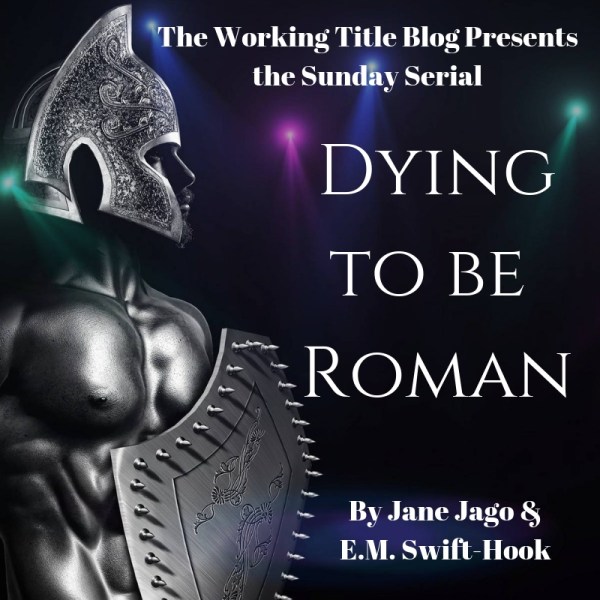
Dying to be Roman by Jane Jago and E.M. Swift-Hook is a whodunit set in a modern day Britain where the Roman Empire still rules. If you missed previous episodes you can start reading from the beginning. You can listen to this on YouTube.

They were greeted by a whey-faced curator who seemed to be expecting them.
“That was fast, but I’m glad you are here so quickly – I’ve tried to stop anyone going near the area, of course, but I didn’t want to start a panic by letting people know what had happened.”
Dai opened his mouth but Julia beat him too it.
“Of course. I understand. Perhaps you could take us to see. No need to cause any alarm.”
The curator led the way and Dai shot Julia a puzzled look. She shook her head and winked then took a few quick paces so she was walking beside the curator.
“What can you tell me?”
“Well, the under-keeper found him, said the lions have been very unsettled recently and he had been trying to see what the problem was.”
“The under-keeper was trying to see what the problem was?”
“No. The head keeper. Drust. Ninian Drust. He was a marvel with the lions, he knew them all from cubs. It is terrible, terrible.”
“Terrible,” Julia agreed. “So what happened?”
“He must have been checking the enclosure, looking for anything that might have been upsetting the lions. Would have to have been early morning, before opening. The under-keeper found him when he came on duty just after lunch. Well, found what was left of him.”
They had reached the lions’ enclosure and the curator was wringing his hands over and over.
“Terrible. It’s just terrible.”
Dai caught the slight nod Julia gave him and left her saying soothing words to the curator and hopefully getting more details of events from him. Dai went into the keeper’s room and the stench of exposed entrails hit him full in the face. The keeper’s face was still strangely preserved, eyes wide with a last image of horror, and jaw locked into a teeth-exposing grimace of agony. Most of the damage was to his torso and limbs, the trailing remains of his guts hung down from the table and his body looked oddly deflated with the internal organs and soft flesh mostly gone.
It was obvious he had been attacked and killed by the lions he had loved. Didn’t need a detective to tell that. Dai was anything but a superstitious man and right that moment he was not going to buy into this being any kind of coincidence. His test kit was about as basic as it came but the blood sample told him one important thing: there had been high concentrations of alcohol in Ninian Drust’s bloodstream when he died.
One of the advantages of having a Roman investigator with him was that Dai needed only to ask for his requests to be fulfilled. Instead of being told nothing was going to happen unless and until he provided officially confirmed documentation, a single glimpse of Julia’s ID and the curator was almost offering to shoot the lions himself. The praetorian marksmen who undertook the task after being equipped with appropriated tranquilliser weaponry, were probably more efficient.
The subsequent search of the large enclosure seemed fruitless at first and Dai was on the point of admitting his idea might have been wrong and that Drust had in fact just been drinking and wandered into the lions’ enclosure after all, when he saw it. He had seen it when he first walked into the enclosure, they all had. You couldn’t miss it, but no one had really seen it.
“Hiding in plain sight,” he told Julia, pointing to the decorative carousel-shaped centrepiece in the middle of the enclosure. It’s top, a strange confection of oriental shapes, would just be visible to visitors to the menagerie from the edge of the enclosure. The only people who would ever know it was there would be the lion-keepers themselves – and someone who had access to the complete plans for the entire Augusta Arena complex, of course. It looked for all the world, close to, like some intricate cage-effect sculpture, set around a large rough-hewn rock.
The bars were not even locked and lifted easily when Dai applied his strength to do so. So easily that it was clear they were well maintained despite the appearance of age. Even Julia could have opened them without too much trouble.
“The under-keeper told me that Drust was convinced something was going on with the lions at night,” she told him as the bars slid up, revealing a steep tunnel dropping away into darkness. “Apparently, they would come in the morning sometimes to find the lions all lethargic and grumpy. But the beasts passed every health check he ran them through. It had become a bit of an obsession for the man,; he had put in more security surveillance around the perimeter, but that had shown him nothing. So, according to the under-keeper, he had been camping out in the menagerie for the last two nights, determined to see what was happening.”

Part X will be here next Sunday. If you can’t wait to find what happens next you can snag the full novella here.

Jane Jago’s Daily Drabble – Three Hundred and Sixty-Three

Mattie cradled her youngest grandchild and looked at his mother over the babe’s downy head.

“Art going to tell me?” she asked gently.

Her daughter pleated the sprigged cotton of her skirt with nervous fingers.

“Thoui’t think me a fool.”

“Try me.”

“Mam. When did anyone last call thee by thy given name?”

“Long before thy birth, my love.”

“Once we married your da called me Wife. Then when Will was born, I became Mother.”

“It ain’t right, Mam.”

Mattie put her hand over Elizabeth’s.

“It’s the price we pay, love, for healthy babies.”

“Aye Mam. I reckon it is.”

©jj 2019

The Lighthouse

They built him on the hillside, facing out to sea
His eyes glowed red to light the route
To harbour’s calm safety
In his hand he held a blade, upraised to serve and save
A beacon, hero, brought  them home
The honest and the brave
He served the fishers and the folk, who gave him not a name
And ten times ten the winters passed 
Until his sword took flame
Until he walked the naked land, until he took his due
The metal man who lit them home
Sent them to Hades too

©jj 2019

Weekend Wind Down – One Week

A short fiction by Jane Jago. You can listen in to this on YouTube.

One week…
At the time it hadn’t seemed like too much to barter with the little man with the domed skull who had offered a solution to her predicament. At first he had asked for her virginity as a downpayment, but when she laughed and pointed out that it was a rose that had been plucked a good while since he had pushed out his long upper lip and made an old-maidish tisking noise. But then he had brightened. His master, he said, would be content with a week of her company in recompense for helping her out. At a time convenient to her, of course. 
She had agreed hastily, frankly in so much fear of the consequences of her actions that she would have agreed to anything he suggested. Now, however, with the threat of prison no longer hanging over her head, she would have dearly loved to wriggle out of the deal, but there seemed to be no escape. 
It was, therefore, with a fairly bad grace that she boarded the Eurostar for Brussels on a freezing cold Sunday afternoon in the pouring rain.
“Belgium…” she mused inwardly, “who lives in Belgium?”
That was a question that she was never to have answered. A pressed and barbered chauffeur, carrying a huge umbrella, met her on the station concourse and escorted her to a waiting limousine. He tenderly helped her into the rear of the vehicle.
“Our journey will be of about four hours duration, madam.”
She nodded as regally as she could, whilst mentally trying to pin down his middle European accent. 
He got into the driver’s seat and the vehicle moved away as smoothly as if it ran on ball bearings. The sound of the doors locking was almost shockingly loud. She reminded herself that her own more modest saloon car performed precisely the same function when the speed reached ten miles per hour, but that was of very little comfort as she looked at the chauffeur’s shaven neck and the way his cap was placed precisely centrally on his almost square head. Not normally a woman noted for her imagination, she gave herself a mental shake, but couldn’t rid herself of a small worm of dread lurking deep in the pit of her stomach. 
The journey seemed endless and she was only able to endure it with to
tolerable equanimity by concentrating on her own breathing and looking out of the window at the sheets of rain. As the day grew darker, the rain grew increasingly sleety and by the time they turned off the autobahn onto what was obviously a private drive it was snowing in earnest. The woman examined her own perfectly manicured fingernails and wondered just what she had allowed herself to be manoeuvred into. Pushing half a million dollars worth of assistance out of a sticky situation to the back of her mind, she allowed herself to feel misused.
The big car swished to a halt beside a set of ironwork gates. Her driver rolled down his window and said something she didn’t catch. The gates slid open and the car picked up speed again. Only now they were driving through a rocky tunnel. She shivered involuntarily. The tunnel was dark and it seemed that the headlights barely pierced the gloom. 
“Almost there madam.”
That wasn’t exactly reassuring either.
Not being a fanciful woman, she wasn’t sure why her heart dropped to somewhere in the region of the needle-sharp heels of her boots when the car stopped outside the deeply carved, black walls of an ornate castle. Walls that were being rapidly decorated with white snow frosting. Somewhere in the very back of her mind she heard the words ‘Castle of Otranto’ and some long-forgotten fear grasped her by the throat. At that moment, had there been anywhere to run she would have fled. But there wasn’t. Instead she set her foot on the bottom step and mounted the worn stone steps, bending her mind to grace and suppleness grace in place of gaucherie and fear. 
As she reached the huge doors one leaf was thrown open and a cadaverous figure in the dark suit of a butler stood regarding her. She was a woman well accustomed to servants, so she glided past paying him no more heed than if he had been one of the gargoyles that glowered down on her from the dark stone walls.
Inside the place a huge fire burned in the sort of grate that could have accommodated a whole tree. A servant bustled forward and took her coat. She automatically fluffed her hair and touched fingers to her perfectly painted lips before turning to face the figure that uncurled itself from a huge chair beside that crackling fire. For an instant she saw, or thought she saw, grey scaly skin, yellowish teeth, and long bright claws on strangely articulated fingers. But then the image wavered and all she could really begin to focus on was icy green eyes with vertical slotted pupils. She thought she might have been about to faint, but she was not granted even that small mercy. However, she had never lacked courage and walked to meet her fate with a straight spine and a cool smile. 

One week…

One week can be a lifetime or as fleeting as a passing breath. 
From that day until the end of a pampered and hugely successful life she could never decide which she experienced. All she knew for certain was that whatever happened to her in those seven days she must have pleased Him greatly to be allowed to leave on her own two feet.

Jane Jago

Jane Jago’s Daily Drabble – Three Hundred and Sixty-Two

Knut looked at the gesticulating man with some hauteur. He was sitting on his own doorstep, and minding his own business, and, as far as he was concerned, the human needed to mind his business.

Missus came to the door, laughing, she bent to run her fingers through his ruff. 

“D’you think the big man’s afraid of you?”

Knut let his tongue loll and thumped his tail.

In the end the man went away, and when Mister came home he was lavish in his praise.

“You protected well.”

Knut stuck out his chest. He loved Missus, and he was proud.

©jj 2019

Start a Blog at WordPress.com.

Up ↑