The Chronicles of Nanny Bee – Summer Bloomers

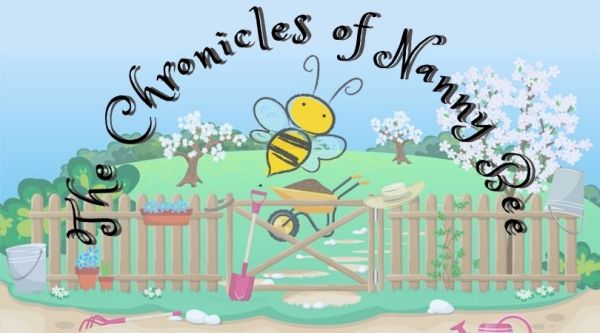
They called her Nanny Bee, although as far as anyone knew she had never been a wife or a mother, let alone a grandmother. But she was popularly believed to be a witch – so Nanny it was. She lived in a pink-walled thatched cottage that crouched between the village green and the vicarage. The Reverend Alphonso Scoggins (a person of peculiarly mixed heritage and a fondness for large dinners) joked that between him and Nanny they could see the villagers from birth to burial.
Nanny’s garden was the most verdant and productive little patch you could ever imagine, and she could be found pottering in its walled prettiness from dawn to dusk almost every day. People came to visit and were given advice, or medicine, or other potions in tiny bottles or scraps of paper – but they always had the sneaking suspicion they were getting in the way of the gardening.
But there again, digging is second nature to gnomes.

Items of feminine apparel were going missing from washing lines. The summer sun and breeze was encouraging the washing of bed linens, winter clothing – and underwear.
But the underwear couldn’t always be found when the washing was picked in to be ironed.
Somebody somewhere was in possession of many pairs of linen bloomers, but nobody knew who.
The village constable investigated to no avail so he did what everyone did when something was above their pay grade – he went to see Nanny. The two of them sat in her fragrant garden, she was puffing on her pipe and he had a leather tankard of ale in one large pink hand.
“Us’v laid in wait, but when us does the he never comes. Un seems to know…”
“Then I suspect they does know.”
The constable scratched his head. “I don’t get it, missis.”
She patted his meaty arm. “Never mind. You just leave it with me.”
He finished his beer, belched quietly and left.
At sundown Nanny had a conversation with a friendly magpie before making her way into the forest.
She sat on a fallen tree.
“I’m waiting.”
Nothing happened for a while, but then a procession of strange little people came into sight.
Fauns wearing linen coifs and with white linen bloomers covering their hairily goatish lower limbs.
Nanny sighed. It was going to be a long night.

Jane Jago

Jane Jago’s Summer Stories – Crossing

Crossing had never been more than a one-horse town, but when the railway shut down and the boys got drafted into the army it stopped even being that. 
We women done our best, but with kids to raise and mouths to feed the soil become more important than the saloon bar, and the horse pretty well took over from the truck. Them few of us brave enough to drive a car pretty soon found that there warn’t any fuel to be had anyway. It was all going to the war effort – whatever in tarnation that meant.
And that’s pretty much how it looked right up until the boys come home, one dirt street with rusty trucks leaning drunkenly on their useless tyres and hosses picketed under the shade trees outside the deserted saloon. 

The winter of forty-five was hard and the men what drifted home warn’t nothin’ like the boys that went off to fight the old men’s war. They come home thinner, and harder, and somehow soured by what they seen and done. And that ain’t counting the ones that never come home.
I wasn’t expecting nobody to come home for me and mine. My durn fool of a husband got hisself killed bein’ a hero in some battle a whole ocean away. I think I musta shed a tear when they sent me a wire sayin’ he was gone, and I kinda had to look properly sad when a big fat man in a general’s uniform brung along his medals and pinned them on nine-year-old Jethro Junior’s chest. But, jest between you and me, all I was really thinkin’ was what a pigheaded eejit I had married. Jest couldn’t keep his head down and his nose clean and come home to me and the little ‘uns.

During the spring and summer of forty-six I looked about me and seen what war had done to our menfolks. I was almost glad that my Jethro never come home – him having been a hard sort of a customer even before the scars of war. Seemed to me that what the war broke there wasn’t no amount of lovin’ nor understandin’ gonna be able to put back together. Seein’ as how I was a nurse and worked in the hospital in Big Town (until Pa decided I had to come home and marry Jethro) I seen with my own eyes what the men hereabouts come home capable of. I tended broken bones, bruises in every colour you can imagine, and the ragged cuts caused by bullwhips bein’ wielded in drunken hands. All in all I reckoned I was better of alone.

The winter of forty-seven seen Pa called to his maker, but before the influenza took him he signed a lawyer’s paper leaving’ the property to me. That surprised me some, him settin’ so much store by the male line, but he smiles at me and says I’m more of a son than any man could ever be. Brung a lump to my throat that did, and as I nursed him through the cruel cold I kep’ myself warm with the knowin’ that me and the kids was safe.

Summer rolled around and I was milkin’ the most awkward of our three cows when I heard a engine. Something was toilin’ up the dirt track to the farmhouse. Now we never knew nobody with no truck, so I let the cow go and sneaked around back to where I could pick up Pa’s Colt and make sure she was loaded fer bear.

By the time a rusty rattler of a Holden scraped to a stop I was settin’ on the stoop watchin’ the yard from under the brim of my greasy old Stetson. The man what stepped out might a bin Jethro’s twin. Same handsome face. Same swagger. Same hard, cold little eyes. I pushed back my hat with two fingers.

“Howdy,” I said. “Help ya?” 
“I sincerely hope so. I’m looking for Dorothy, widow to my Cousin Jethro Tomkins.” He smiled at me, but his smile never reached his eyes. “Might that be you.”
“Might be.” I offered him a grin. “Set a spell and tell me what brings you to these hyar parts.”
“I come to look over my property.”
“Your property?”
“Yes. Mine. Cousin Jethro done left it to me in his will.” 
“That’d be a trick, seeing as how he never owned it in the first place.”
I settled my hat back down over my eyes and leaned back in my chair.
He was just stupid enough not to go for his gun. Instead he made a grab for me.
“Smart-mouth woman needs slapping down hard.”
He fisted his hand in the front of my shirt and I shot his fool head off.
Me and the kids buried him back aways in the scrubland before the mesquite starts.
We keeps chickens in the Holden in his memory…

Jane Jago

Dog Days – Pawprints

The Dog Days are the high days of summer and a perfect time to celebrate our canine companions in verse and prose.

Pawprints in the kitchen
Pawprints on the floor
Pawprints on the furniture
Pawprints on the door
Pawprints on the patio
Pawprints from the shed
Pawprints running up the stairs
Pawprints on the bed
Pawprints on the landing
Pawprints in the hall
Pawprints by the front door
Pawprints on the wall
Pawprints running everywhere
I don’t know where to start
I’d curse the mangy mutt but he’s
Run pawprints through my heart.

Eleanor Swift-Hook

The Trials of Arthur Whitty by Tim Walker

Out today, The Trials of Arthur Whitty by Tim Walker, is a novella about plain old Arthur Whitty, a man whose dreams are never dull and whose vivid imagination and sense of humour carries him through a series of sometimes challenging situations. Arthur has retired to a pair of slippers and jigsaw table in a quiet cul-de-sac in Berkshire, England. He walks his dog, Max, and lets his mind wander to a series of dreams in which he is more daring, skilful and adventurous that his real-life humdrum self. He is an irritant to his orderly wife, Emilia, and has succumbed to irksome cancer treatment following a run-in with skin cancer.
Once a date has been set for corrective surgery, Arthur sets his mind on organising a real-life adventure – a bucket list trip to Machu Picchu in Peru where he finds peace and a calming of the spirit. Arthur’s bullish nature carries him through a series of situations but there is little the retired couple can do about the onset of dementia. But Arthur is well supported by Emilia and their daughter, Holly, as the family rally round to make his declining years as comfortable as possible. And there’s always escape to his secret world of risk, responsibility and danger.
The author has drawn on personal experience and observations of elderly men in a support group he helps run for Men’s Matters charity in Windsor, Berkshire. Half of all royalties from the sales of this book will be donated to Men’s Matters, who support older men by encouraging social interaction and connecting them to health and wellbeing support services.

Extract – Arthur at the Cancer Clinic

Arthur lifted a copy of Country Life magazine from the table and idly leafed through it. He held it up and furtively examined the row of six patients on the opposite side of the room over its top. All were waiting their turn for radiotherapy treatment. Arthur decided that out of the six, three looked worried, and perhaps were pessimistic about their chances of beating silent killer, the Big C. The worriers were fidgeting, their eyes searching the walls for meaning, or redemption. Perhaps they would have less chance of surviving, Arthur thought. In contrast, three appeared more robust, healthier, and seemed less concerned. Did he look unconcerned or did he seem nervous? Did he have the demeanour of a survivor?
“Mister Whitty” the nurse called, and all eyes were on Arthur as he put down the magazine and slowly rose to his feet.

…the last-minute reprieve had not come from the Governor’s office, and Art Whitty’s lawyer mopped the perspiration on his creased forehead with a red polka dot hankie whilst staring at a crushed cockroach on the concrete floor rather than meeting the hollow eyes of the client he had failed.
The plate from Art’s last meal of steak and chips was as empty as his soul; his time was up. It was the most popular choice the orderly had remarked, rather pointlessly, Art had thought, given the gravity of his situation. His tongue licked salt from cracked lips in a final connection of reflex to memory as the sound of metal studded boots echoed along the corridor.
“Add a final entry and take my diary to my publisher. Tell them to publish,” Whitty drawled. “Maybe they’ll find out who really killed Mary Lou Randall after I’m gone and the second edition will be a bestseller.”

“Please remove your jacket and lie on the table, Mr Whitty,” the nurse said, pointing to a paper-covered mortuary slab.
Arthur followed instructions and was soon staring up at what looked like a vintage hair dryer attached to a robotic arm. A technician in a white coat consulted his file and pointed the gun end of the device at the scar on Arthur’s head where a cancerous lump had been surgically removed a month earlier.
“Lie still, Mr Whitty, it will flash and make a clicking noise.”
The tech and nurse donned tinted goggles and scrambled behind a screen, crouching to avoid the radiation, as if members of Oppenheimer’s team at Los Alamos. Arthur was left alone with the death ray gun pointing menacingly at his head. Ready, aim, fire. Then a beep, click and flash, and it was over. A short dose for the patient would hopefully eradicate all traces of the cancer, he had been told. Drastic perhaps, like a Medieval kill or cure remedy. But what residual damage would there be to his brain and cognitive function?” It was a question his radiologist had ducked.
“Only three more treatments,” the nurse said as she returned Arthur to the waiting room. He felt moved to give his fellow condemned a smile and thumbs-up. A nervous woman returned his smile, her eyes darting from his face to a ghastly health warning poster.
Emilia was waiting for him in reception, and they departed the sacred space in reverential silence, heads bowed, hoping for a sign.
“How did it go?” she asked over the roof of their car.
Arthur slid into the passenger seat and rubbed his scar. “Fine, dear. I’ll soon have enough radiation to open the garage door with nothing more than a hard stare.”

The Trials of Arthur Whitty by Tim Walker is out today!

Author Profile
Tim Walker is an independent author living near Windsor in the UK. Born in Hong Kong in the Sixties, he grew up in Liverpool where he began his working life as a trainee reporter on a local newspaper. He went on to attain an honours degree in Communication Studies in South Wales before moving to London where he worked in the newspaper publishing industry for ten years.
In the mid-90s he opted to spend a couple of years doing voluntary work in Zambia through VSO, running an educational book publishing development programme. After this, he set up his own marketing and publishing business in Lusaka, Zambia’s capital, then managed a mineral exploration company before returning to the UK in 2009.
His creative writing journey began in earnest in 2014, as a therapeutic activity whilst recovering from cancer treatment. In addition to short stories, he researched and wrote a five-book historical fiction series, A Light in the Dark Ages. The series connects the end of Roman Britain to the story of Arthur in an imaginative narrative. It starts with Abandoned, then Ambrosius: Last of the Romans; Uther’s Destiny; Arthur Dux Bellorum and Arthur Rex Brittonum, the last two books charting the life of an imagined historical King Arthur.
More recently, he has written a dual timeline historical novel set at Hadrian’s Wall, Guardians at the Wall. His two books of short stories, Thames Valley Tales and London Tales combine contemporary and historical themes and are now available as audiobooks. Somewhere along the way, he co-authored a three-book children’s series with his daughter, Cathy, The Adventures of Charly Holmes.
You can find Tim on Goodreads, Facebook, Instagram, X (Twitter), TikTok, BlueSky and his own Website.

How To Be Old – A Beginner’s Guide! (2)

Advice on growing old disgracefully from an elderly delinquent with many years of expertise in the art – plus free optional snark…

You are old so you shouldn’t do that
You should only like knitting. And cats.
It shouldn’t be you
With a brand-new tattoo
Making love on an old yoga mat

© jane jago

Blossom

As delicate as breath
And as soft as a sigh
Knitted from light
Brings joy to the eye
One trembling blossom
Once perfumed, once sweet
Falls underfoot
And is crushed in the street

© Jane Jago 

Roguing Thieves: Part One

A sci-fi story of love, betrayal and Space Pirates!

She was heading home.
Pan stood in the spaceport only half-believing it.
Five years was a long time to be away.
The certificate awarding her qualification in astrotransport design and engineering, sat on her profile so she could see it every time she checked her link. She needed it there as it was still something of a struggle to accept she’d not only completed the course successfully but aced the grades to get a top tier ranking.
An arm sneaked around her waist and squeezed.
“I’m going to miss you.”
She looked up to see Tolin, his gaze drawing her in as it always did. She had never seen anyone’s eyes actually sparkle before she met him. Turning into the embrace, she slipped her arms around his neck so she could pull his head down for a long kiss.
“I’m missing you already,” she said when their lips finally broke free.
He smiled, making her think of every romantic hero of her teenage years. He had the body of an athlete and the chiselled good looks of a male model. Each time she saw him she felt a weird disconnect deep in her solar plexus. They had been together for the last five cycles, nearly half a year, but she still couldn’t quite believe it.
Tolin had walked into her life quite literally. She had been heading out of the simulator suite after one of her sessions testing a design theory she was working on, and he had walked in through the door, so lost in his augmented links that he nearly barrelled into her. At the time she had been completely caught up in the work she still had to do, so she hadn’t paid him much attention. But he had insisted on a fulsome apology and keen to escape so she could write up the results, she had agreed to meet him for a meal in the student cafeteria.
That was when, somewhere between the soup of the day and the fruit salad, they had fallen in love.
Tolin was there to upgrade his pilot’s licence. He was a freetrader and had just made enough credits to be able to up his licence from Class D – restricted cargo and no passengers – to the Class C which allowed freetraders to carry most regular cargos and occasional passengers. It was the baseline for making any kind of decent living.
They moved in together a few days later and shared bills and a bed for the rest of the semester which was Pan’s final session and Tolin’s only one.
But all good things come to an end and here they were. Pan wondered where this left them now. She had a whole stack of job offers to consider, one or two even in Central. Those were the ones she was most excited about. A job in Central meant she would have the right to live there, the right to bring her family with her. It was something she was going to have to work on and she wasn’t sure where Tolin fitted into things. He seemed to sense her mood and pulled her close again.
“I already told you not to worry about me, Pan. I’ve got a business to build and you’ve got a career to start. Let’s see where we are this time next year.”
A whole year.
She opened her mouth to protest and he covered it with a kiss.
“Or maybe less. Tell you what, soon as you have your first vacation time, we’ll take off somewhere. Wherever you want.”
His eyes sparkled and her heart was lost.
“Promise?”
He laughed.
“If you do.”
“I love you Tolin Dreen.”
“And I love you Panvia Dugsdall.”

Mulligan’s Reach was a planet in the Periphery of the Coalition that had very little of its own resources to attract the rest of the galaxy but was perfectly placed to be a trade hub for the further hinterlands of the Sector. As such it had a reasonable tech level, lots of space, but not much by way of wealth trickled down to the locals.
Home was a small house on the outskirts of the one major city. The land here was dry, as rain seldom fell. It needed constant irrigation from the well-maintained network of waterways. The best land on the banks and floodplain of the wide Reach River, had been bought up for intensive farming by one of the corporations long ago. But a few small farms struggled on the marginal land between that and the city, then beyond them some even smaller holdings which allowed their owners a chance to supplement whatever income they might make by other means.
It was to one of these that the groundcab took Pan. In a row of identical buildings, all of an age to need ongoing repairs to stay sound, it stood out as the one with the most foodstuffs growing around it and the least well-maintained facade.

Roguing Thieves is a Fortune’s Fools story by E.M. Swift-Hook. There will be more Roguing Thieves next week…

The Chronicles of Nanny Bee – Marriage Guidance

They called her Nanny Bee, although as far as anyone knew she had never been a wife or a mother, let alone a grandmother. But she was popularly believed to be a witch – so Nanny it was. She lived in a pink-walled thatched cottage that crouched between the village green and the vicarage. The Reverend Alphonso Scoggins (a person of peculiarly mixed heritage and a fondness for large dinners) joked that between him and Nanny they could see the villagers from birth to burial.
Nanny’s garden was the most verdant and productive little patch you could ever imagine, and she could be found pottering in its walled prettiness from dawn to dusk almost every day. People came to visit and were given advice, or medicine, or other potions in tiny bottles or scraps of paper – but they always had the sneaking suspicion they were getting in the way of the gardening.
But there again, digging is second nature to gnomes.

It was a sunny Sunday morning and Nanny was listening to the church choir while she pricked out some seedlings. She was idly wondering who possessed the piercing soprano that was permanently half a beat behind the rest when a shadow fell over the potting shed. She put down her dibber and went outside. A winged horse hovered over her tiny lawn.
“Ho sister,” it said, “there’s trouble at the castle and you wanted immediately.”
“If His Greediness has got himself indigestion again, I ain’t coming.”
“No. It isn’t that. There’s something happened to the lordling. His wife is in her chamber sobbing and he’s nowhere to be found.”
“Oh right. Hang on. I’ll just get my bag.”
“And maybe change your gardening boots?”
“Oh. Right. Okay. I’ll come out the front door.”
It’s not every day that you get to ride on the back of Fledge his own self, but Bee was a prosaic being and rather resented being pulled away from her petunias.
Fledge dropped neatly to earth in the stable yard and walked quietly to the mounting block. Nanny jumped down and bowed to the horse.
“I thanks you for my safe ride.”
“You are welcome.”
The castle functionary who awaited her sneered down from his great height. Nanny ignored him and stumped off towards the private apartments. To his chagrin, the tall clerk had to run to keep up with her. The door guard saluted her with his pike before winking broadly.
She walked sturdily into the formal presence chamber and chaos. There appeared to be upwards of a dozen people all shouting at the very tops of their voices. The only pool of silence centred around a slender figure cloaked in rose-pink velvet, who stood right in the centre of a patch of sunlight. She turned her perfect face and smirked at Nanny, who chose not to notice her.
“You’ll have to be polite to me when I have the young one’s ring on my finger,” beauty hissed.
“Oh. I doubt it,” Nanny spoke absentmindedly as most of her brain was taken up with assessing the situation around her.
As far as it was possible to make any sense, the Lord and his Heir were nose to nose and both were puce with rage. Her ladyship was alternately screaming like a banshee and having recourse to her lace kerchief. The other shouters appeared to be various staff members and functionaries who could safely be discounted.
Nanny ambled over to where father and son were having their ‘discussion’ and knocked politely on the younger man’s knee. He stopped yelling at his father and looked down.
“Ah, Nanny,” he said genially, “can you make this old fool see that I’m firm in my resolve.”
“Your resolve to do what, sir?”
“Why to divorce my unfaithful wife and marry my true love.”
Nanny looked into his fair and foolish face and sighed. She beckoned and when he bent down he was felled by a scientific blow from a knobbly little fist.
As soon as he hit the ground the air wavered about beauty and she began to look less beautiful. She looked at Nanny with loathing before she picked up her skirts and ran.
“When he wakes up he won’t remember any of this. But somebody needs to explain to his wife that she is NOT to withhold his conjugals if she don’t want this to happen again.”
Nanny went back to her petunias, deeply grateful that gnomes only consider sex in an abstract manner, and only as it pertains to other people.

Jane Jago

Jane Jago’s Summer Stories – Blank Page

I wasn’t afraid, but to another woman his heavy cold hand would have been terrifying.

As he ushered me into the room I kept my eyes lowered and my thoughts to myself.

“The place of books.”

His oddly sibilant voice echoed through what instinct told me were locked bookcases. The lectern in the centre of the room with its single open volume called my feet and we walked.

Before I stopped, I knew what I would see. Emptiness. Hungry, impotent, emptiness.

“Touch it.” My escort sounded oddly desperate.

I turned to face him and made my voice mildly incurious. “What is today, Messire Scarlett.”

“It is Thursday the forty-third of Summer, my lady.”

I turned back to the book, and, even as my escort made to press my hand to the vellum, I moved, snake-quick, so his own hairy palm kissed the blank page.

And the moving finger writ.

Marmaduke Scarlett – born Monday the fiftieth of dark winter, deceased Thursday the forty-third of summer. 

Scarlett screamed as his body decomposed around him until there was naught left but an evil smell.

It is hard to be afraid when there is nothing out there more terrible than you…

Jane Jago

Dog Days – Big Denzil

The Dog Days are the high days of summer and a perfect time to celebrate our canine companions in verse and prose.

It was a breathlessly hot day, and the feral dogs were mostly gathered in the shade of an olive grove. Big Denzil watched his mate pick her way between the sleeping forms. He greeted her.

“Do you walk well, mother of my pups?”

“I do,” then she flattened her ears to indicate amusement. “One’s eldest male pup is feeling less well though.”

“Tell on, my beloved.”

“He and Three-Toes found a dead fish down by the cistern. A long dead fish. Three-Toes’ dam warned them.”

“But they knew better?”

“They did. And they were as sick as humans…”

Jane Jago

Start a Blog at WordPress.com.

Up ↑