Miranda

Miranda was delighted that fashion had changed.

Not so long ago she had needed to ask her friends, regarding every new item of clothing she got:

“Does my bum look big in this?”

She knew their polite denials were from kindness and she spent many years wearing nothing but baggy joggers or long tunic tops to cover that unfortunate derriere.

Then things suddenly changed.

Big bottoms had somehow become all the rage. She was not sure how, or why, but she was utterly thrilled.

Miranda put on her shorts and went out in the street, brimming with new found confidence.

E.M. Swift-Hook

The Chronicles of Nanny Bee – Columbine and Harebell

They called her Nanny Bee, although as far as anyone knew she had never been a wife or a mother, let alone a grandmother. But she was popularly believed to be a witch – so Nanny it was. She lived in a pink-walled thatched cottage that crouched between the village green and the vicarage. The Reverend Alphonso Scoggins (a person of peculiarly mixed heritage and a fondness for large dinners) joked that between him and Nanny they could see the villagers from birth to burial.
Nanny’s garden was the most verdant and productive little patch you could ever imagine, and she could be found pottering in its walled prettiness from dawn to dusk almost every day. People came to visit and were given advice, or medicine, or other potions in tiny bottles or scraps of paper – but they always had the sneaking suspicion they were getting in the way of the gardening.
But there again, digging is second nature to gnomes.

The flower fairies were at it again, and Nanny’s precious garden was littered with torn petals. The beautiful red ballerina poppies under the kitchen window were all but bald, and even the roses that grew over a rustic arch were beginning to show wear.
Nanny went out at midnight and stood barefoot with the scent of crushed camomile drifting up to her impressive nostrils.
“Whoever is responsible for the desecration of my garden had better come forward now. Because if I have to come looking.”
A sound of rustling petticoats and tinkling laughter heralded the arrival of the crew. To be honest they weren’t looking their best and Nanny laughed.
“Whatever is the matter with you? You look like a set of twopenny halfpenny bawds from a low market cathouse.”
Daisy piped up. “The winner gets to bloom all year.”
“Says who?”
There was a bit of foot shuffling then: “Columbine and Harebell done a Ouija.”
The fairies laughed and chattered with real malice.
Nanny concentrated hard and He came – the Lord of Growing things, with his strangely jointed limbs and his yellow caprine eyes. He clapped his hands three times – the fairies fell silent and Nanny’s garden bloomed anew.
He bowed to Nanny before he faded until all that was left were his eyes and horns.

©janejago

I saw you

I saw you on the corner, in the place you always wait
You walked me home like you always do, no matter if I’m late
I heard your voice in the kitchen, deep and sure and fine
I felt your fingers in my hair, and I knew you are still mine
I tasted you on my toothbrush and I smelled you in my bed
I understood what they told me but only in my head
My heart and body won’t believe, they know it isn’t right
So I’ll lay me down with a bottle and I’ll come to you tonight

©️jj 2023

Weekend Wind Down – A Praetorian Farewell

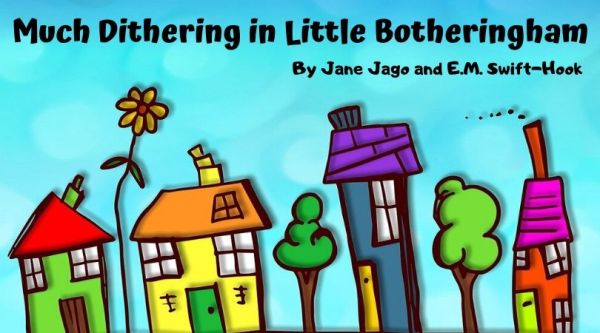
The Dai and Julia Mysteries by Jane Jago and E.M. Swift-Hook, a  whodunit series set in a modern day Britain where the Roman Empire still rules.

Pridie Idus Apriles MDCCLXXVIII Anno Diocletiani

It was much too beautiful a day for saying farewell.
The sun was shining in a mild, blue sky, where the clouds that drifted were picture-book white and fluffy. Spring had sprung with enthusiastic abandon and the fruit trees in the orchards around the Villa Papaverus were smothered with blossoms. It had been a long, cold winter and now new life was bursting out everywhere as warmth returned.
The small squad of Praetorians stood on the apron of gravel in front of the house, standing as if on parade before the Emperor. But the formal leave taking had already been done, yesterday, in Viriconium, when they had marched through the streets having performed an open-air concert in the Forum before the Magistratus and other local officials and dignitaries.
This was different. This was just a rag-tag group of Romans and Britons, citizens and servants. Dai had deliberately avoided wearing a toga. For this event, he wanted to be simply Dai Llewellyn the man, not Submagistratus Llewellyn of Demetae and Cornovii. Beside him, Julia his very pregnant wife, had also avoided anything dressy. She was clad in a simple maternity tunic and long skirt. For this was not the formal dismissal of the vexillation of Praetorians that had been billetted in his villa for the last seven months, this was the parting of friends. This departure had already been delayed past the original time, but the day had finally come.
Dai himself had come to know almost all of these men to some greater or lesser extent, but everyone in the household had befriended one or more. Some had gone beyond friendship and two of the Praetorians had requested – and been granted – early release and the necessary documentation to remain and marry local women. And, with room for tragedy as much as happy-ever-after, three of the younger women who had been working in the villa were now waiting by the gate, packed up, happy glowing faces, to travel with their lovers to Londinium. Dai hoped Julia had spoken to them and told them they would always be welcome back, even if they came with an unacknowledged infant or two in tow. Relationships between Citizens and those who were not, were seldom formalised as the legal barriers to doing so were very high and the pressure these young men would be under from family and friends to marry a Citizen would be immense.
There had been hugs and tears all around, but now, formed up smartly, the Praetorians looked every inch the disciplined elite fighting force they were trained to be. At the front of the squad, facing them, stood Brutus Gaius Gallus. He had been Praetorian Decanus Gaius until the previous day and although he was standing with his spine rigid and his jaw chiseled from granite, Dai was fairly sure he could see a slight overbrightness in the older man’s eyes. It was he who snapped out a final salute and then the troop was marching through the gate to where two army trucks were waiting to take them back to Londinium. Dai wondered why Gallus had chosen to take early retirement and had an odd suspicion that it might have been on orders from the Tribune in charge of the Praetorians in Britannia – Decimus Lucius Didero.
“I’m going to miss them,” Julia said softly. Dai put an arm around her.
“Me too,” he admitted, thinking of the number of times he had needed to call on the Praetorians to provide military back-up since he had started working here the previous September. It was going to be tough without them.
“They were actually rather good musicians,” Julia was saying. “We had some lovely concerts. Now we’ll need to hire in when we hold a party.” She gave a sigh of regret. Dai looked at her sharply and she turned her face up so he could see the sparkle of mischief in her eyes.
“I had you with that one, admit it.”
Dai smiled a little wryly. “I’m probably an easy target.”
Julia reached up and drew his head down to hers for a kiss.
“Not often,” she said as she stepped out of his embrace. “But talking of parties, I have one to finish organising for tonight.”
Dai had almost forgotten that.
Almost.
For today was not only a day of farewells it was also a day of celebration. They were having a family party to welcome home his sister, Cariad. She had been away for the last three months, relaxing on a small secluded island in the Mare Nostrum in the care of an asclepieion, recuperating from nearly falling victim to a murderer.
But Dai struggled to find in the return of Cariad any cause for celebration. His sister was a serial adulterer who cared nothing for anyone or anything except herself, her own desires and her own social ambitions – not her husband nor even her two children. That she was married to Dai’s immediate superior, the local Magistratus, who adored her beyond reason and forgave her every failing, made the situation even more embarrassing to handle.
But he refrained from saying anything as Julia chivvied the household back to work and was about to return to his own administrative labour, when Gallus intercepted him.
“Submagistratus, I have a favour to ask of you.”
Gallus was a man typical of his class and status. You could slice and dice through him at any point and the solid soldier would be left in every piece. He had the typical legionary contempt for civilians – a contempt that extended to the Vigiles which Dai had served for many years. If the last few months had led Gallus to give Dai some grudging respect for his abilities, it had manifested in a patronising attitude, which was unspoken but omnipresent. And that grated.
Dai squeezed out a polite smile. “What can I do for you?”
“It’s the matter of my application to join the Vigiles. The Magistratus informed me that whilst he had approved it, since I would be working in your district I  would need your formal approval as well.”
It took a moment for Dai to recover. He suspected that his jaw must have dropped slightly open, but was struggling so much for words that he could not be sure.
“You? You are applying to join the Vigiles?” Not, Dai realised, his finest moment of tactful diplomacy.
Gallus’ expression became even more severe than usual and his eyebrows lowered into a frown.
“I’ve already been approved for it.” He sounded defensive. “This is just a matter of courtesy as you are -”
Dai lifted a hand, feeling acutely awkward. “No. I mean – I know. You just said.” He took a steadying breath, “I am simply very surprised. The last time I heard you say the word ‘vigiles’ it was with the words ‘namby-pamby’, ‘play-soldiers’ and ‘glorified lost and found service’ attached, as I recall.”
At least Gallus had the decency to look a little uncomfortable at the memory.
“Yes. Well – uh – that – that was different. And it was a while ago.”
“About two weeks.”
Gallus cleared his throat and came to attention.
“Submagistratus Llewellyn, I apologise for any prior comments I may have made that in anyway disparaged or demeaned the Vigiles. They were inappropriate.”
“I agree.”
Gallus expression shifted slightly.
“You agree to approve my appointment as an Investigator to the local vigiles?”
“I agree your comments were inappropriate.” As a form of revenge it was petty, Dai knew, but then the digs from Gallus had been too. Dai saw something harden in the other man’s face and realised that his own behaviour was rapidly becoming equally ‘inappropriate’.
“Look,” he said, his tone conciliatory, “before we make anything formal, why don’t you go and spend a few days working with SI Cartivel and his team? See if you fit in. See if you suit the work and if it suits you. I don’t see any point you signing up if not. You can go down to the Vigiles House this afternoon and I’ll let them know to expect you.”
For a moment the grey eyes of the older man held his gaze with the familiar, appraising look that Dai found so profoundly irritating. Then Gallus saluted smartly.
“As you instruct, Submagistratus.”
Dai watched him walk smartly towards the gates and then made his own way into the house. His Senior Investigator and friend of many years standing, Bryn Cartivel, was going to love this. Not.

From ‘Dying to be Welcome’ one of the exclusive bonus short stories The Second Dai and Julia Omnibus by Jane Jago and E.M. Swift-Hook.

Granny Knows Best – Random Indignation

We live in an imperfect world, peopled by imperfect humans. 

Except the shining ones. The social media illuminati whose antennae are so exquisitely tuned and whose sensibilities are so perfectly nuanced that they take it on themselves to police the rest of offensive humanity.

They will have gained some notoriety, which they propose to use to bludgeon the rest of the world into their way of thinking.

They would be better occupied discovering whether or not there is offence being caused before exercising their opinions.

Do not rant on anyone’s behalf before asking, politely, if such is necessary, or acceptable.

Enticknapp

Enticknapp was sitting among the cabbages considering his options. He knew he had been a bad puppy and he rather thought a spanking might be on the cards. 

Maybe he should just run away.

But if he ran away he would never see the small human again, and he loved her.

He cried a puppy tear and crept out of the cabbage patch to face his punishment.

Boss man spied him and bent to pick him up with gentle hands.

“Never mind, puppy,” he said. “It was my fault. I didn’t let you out when you woke up.”

Enticknapp smiled.

Jane Jago

Starship Troopers by Robert Anson Heinlein reviewed by Moonbeam Farquhar Metheringham IV

Starship Troopers was not a book that one had any intention to read.

Ever.

The blurb made it abundantly clear it was about boot camp and killing insectoid aliens in great quantities and the antithesis of everything that represents fine literature. To one, such as oneself, raised upon more the most sophisticated themes and rarified tomes by She Whose Name One Is Unfit To Mention, it seemed like being asked to enter into a rugby scrum only after ensuring two weeks of torrential rain have softened the pitch.

So why would I do such a thing? One hears the single nonplused warble resonating from my myriad readers. You can be sure, gentle people, it was through no choice of oneself.

This is a cautionary tale that tells how karma always finds a way.

Last month I was prevailed upon to join the local literati gathering – or ‘Ben’s Book Club’ as it is is listed on the Community Centre noticeboard. Mumsie had declared that it would be of great value to my own written words were I to take more time to peruse those of others. She also threatened to evict me from my writing sanctuary and turn it into a hell-hole brewery for her own vile alcoholic distillations if I refused.

So, perforce, enforced by force majeur, I went. The torrid event occupies an entire afternoon each week, filled with in-depth and avid discussion and dissection. Then, once the local gossip is dealt with, the group spends a few minutes at the end considering whatever book Ben has chosen for the week and being assigned one to read for the next.  The first week I went it was Starship Troopers by Robert A. Heinlein.

My Review of Starship Troopers by Robert Anson Heinlein

A young man goes to boot camp and learns how to fight insectoid aliens so he can vote. The rest of the book describes the fighting. Spoiler: he doesn’t vote at the end of the book.

Stars: Four – for allowing me to learn sufficient juicy gossip from Ben’s Book Club members to blackmail Mumsie into letting me keep my writing sanctuary.

Moonbeam Farquhar Metheringham IV

You can find more of IVy’s profound thoughts in How To Start Writing A Book courtesy of E.M. Swift-Hook and Jane Jago.

Gryff

They had come so far.

Anna carrying baby Nin while Caradoc had their few worldly goods and Gryff followed loyally. But now the way ahead was barred by a river they could see no way to cross.

Caradoc put his arm around Anna’s shoulders.

“We tried, lass. But life’s not a fairytale. Sometimes the bad people win.”

She buried her face in his shoulder to hide the tears that sprang into her eyes.

Gryff’s sharp bark made her look round.

There was a boat hidden in the reeds.

“So it was a fairytale after all,” Anna always told the grandchildren.

E.M. Swift-Hook

The Chronicles of Nanny Bee – Chocolate Brownies

They called her Nanny Bee, although as far as anyone knew she had never been a wife or a mother, let alone a grandmother. But she was popularly believed to be a witch – so Nanny it was. She lived in a pink-walled thatched cottage that crouched between the village green and the vicarage. The Reverend Alphonso Scoggins (a person of peculiarly mixed heritage and a fondness for large dinners) joked that between him and Nanny they could see the villagers from birth to burial.
Nanny’s garden was the most verdant and productive little patch you could ever imagine, and she could be found pottering in its walled prettiness from dawn to dusk almost every day. People came to visit and were given advice, or medicine, or other potions in tiny bottles or scraps of paper – but they always had the sneaking suspicion they were getting in the way of the gardening.
But there again, digging is second nature to gnomes.

When eating brownies was first mentioned in the village, there was a certain amount of disquiet: cannibalism and all that. But when it was discovered that the brownies in question were delicious cakes that put an entirely different complexion on the whole thing.
The cake was delicious, dense and chewy and sweet, and the village embraced it with enthusiasm.
Nanny, however, was less enthusiastic and she found a surprising ally in the corpulent person of the vicar who came to air his disquiet.
“There’s no doubt the stuff’s beyond edible,” he said. “But that doesn’t mean it’s safe. It’s from the future and shouldn’t be here.”
“Agreed. But I don’t know how it gets here.”
“Neither did I until this morning. I went out for a fly because the dawn was calling and I saw him.”
“Saw who?”
“The baker. He’s found a wormhole and he’s swapping rocks from the spoil heap of the dwarf mine for trays of cake.”
“Where?”
He showed her and she had a word with the mine foreman. Who was unamused.
When the baker arrived at his wormhole the next morning he was driven back by knobbly dwarfish fists and his source of cake had been dynamited into oblivion.
It took a while, though, for the village to forget the forbidden savour of chocolate.

©janejago

Colourful Lives

Nowadays lives are all lived most virtually
Virtual pictures with filters applied
Everyone now can be kept in a pixel
And our photo albums in small phones reside

I recall times that we lived in monochrome
Black and white telly, and black and white snaps
Black and white memories stare from the photographs
Black and white moments our lifetime maps

Back before then they all lived in sepia
Sepia pictures in sepia frames
Formally posed with hands in laps folded
Gazing from history, lost – without names

Further before that they lived life in oil paint
Brilliant colours that spring from the past
Glorious scenes of magnificent ancestors
Whose mighty deeds will our own deeds outlast.

E.M. Swift-Hook

Start a Blog at WordPress.com.

Up ↑