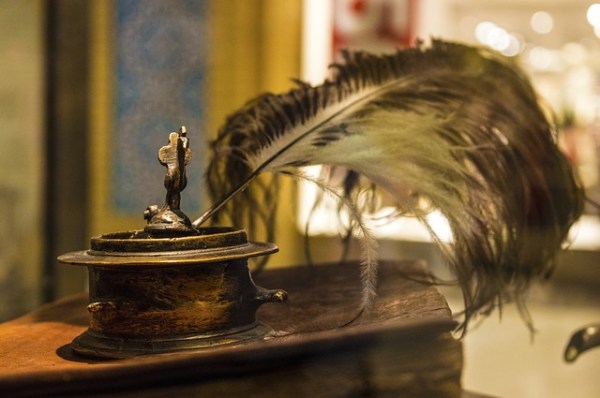
The Thinking Quill

Dear Reader Who Writes,

It always behoves me to assume that there will be at least one new reader of my inspirational course on ‘How to Write a Book’. So to that gentle reader I doff my hat and reveal that I am none other than Moonbeam Farquhar Metheringham IV – author of the  brilliant and inventive novel, “Fatswhistle and Buchtooth”, a seminal work exploring the furthest conceptual reaches of science fiction and fantasy.

Today’s topic came to me a while ago and then I was distracted by my Muse offering other, more pressingly urgent dangleberries of wisdom and demanding that those took precedence. But then my focus was rehoned to the point by Mumsie walking into my writing cave, bearing her trademark pernod and gingerwine in a champagne flute with the inevitable green olive drifting in the murk. “Oh my god, Moons, this place stinks worse than a sumo wrestlers jock-strap!” I delicately pointed out that she was referring to my vetiver, bergamot and lemongrass aromatherapy oil, blended expressly to induce higher states of creativity.

Mummy was not, however, much impressed by this revelation. Instead she picked up my pristine first edition copy of Fatswhistle and Buchtooth and opened it, bending the spine and splattering droplets of her alcoholic creosote over it’s pages. Before I could recover from the horror of her deed, she had dropped the irreplaceably precious item back on my desk. “Don’t they say you can’t tell a book by the cover? Got it wrong with yours though. Shite inside and out.”

How to Write a Book – Lesson 14: The Write Cover.

A book cover needs to be a visual precise of your prose. It should capture and enrapture the roving eye as a reader runs through the rows of books either on a shelf in a shop or on a scrolling screen. Yours must be the cover that cries out as that putative reader sifts through stacks of books to find their next favourite fiction.

But how is this achieved? If you read the academic artists they will talk of proportions, the Golden Mean, of colour strengths and shades and other esoteric claptrap. It is actually stunningly simple – make it red.

Red is the most eye-catching colour as everyone knows. We are all primally preprogrammed to see red as a signal of something requiring our attention. Therefore, so long as your cover is red your book will be read.

A more sophisticated and subtle touch can be achieved by drawing on that other universal colour combination guaranteed to draw the eye – black and yellow. Our perceptions are precisely honed to hover our eyes on anything that resembles hornets or wasps. So, if red is not appropriate for your magnificent tome – black and yellow may well serve the same end.

Of course, to be sure, combine the two concepts.

Oh and put a naked lady on it, ideally headless.

Follow these infallible rules and you will create a cover that none will miss and your book will bound from shelves be those physical or metaphorical.

Until next time, au revoir mes petites poissons.

Moonbeam Farquhar Metheringham IV

Adoring Fans can join my Facebook Group.

Friday Friends – from The Vigil by Diane Morrison

He woke with a start. Glancing all around him, getting his bearings, he realized it was still dark, and most of his travelling companions still slept. Piper, with her mouth agape, was snoring and drooling, as usual. Above him, the sky was a canopy of brilliant starstuff. The Milky Way painted a brilliant stripe across the sky. In the distance, the wind was still blowing over the hollow pipes of the Ancients, like ghosts blowing on bottles.
His father was the one keeping the watch. Colin Walsh sat up on Emma’s carriage with his rifle across his lap. He nodded to Graeme when he saw him sit up.
Graeme crawled out of his bedroll and rubbed at his arms. Cold tonight, which wasn’t a surprise, considering how clear it was. He threw his duster and hat on, picked up his gunbelt, and climbed up to sit beside his father. “What time is it?” he asked in a low voice.
The elder Slinger glanced at his pocket-watch. “’Bout half past one.”
“Why didn’t you wake me up for my watch?” He should have started half an hour ago!
“Way you was sleepin’, reckoned you’d be up soon enough.” He drew out his cheroots and passed one to Graeme without a word.
Graeme hopped down to light a stick from the low-burning embers of their campfire, then brought it up so they could light the little rough-rolled cigars.
“You’re too young to smoke,” growled his father, gazing off at something in the distance while he puffed. Graeme didn’t say a word. Should he put it out? But then his father sighed. “You’re too dang young to be a Slinger too. But you are, so what can I say?” He passed the flaming stick to Graeme.
“You could say you’d rather I didn’t.” He got a good smoulder going, carefully keeping one eye closed to preserve his night vision, and shook the kindling out.
“You’re makin’ adult decisions now. I got no right to tell a grown man he shouldn’t smoke. “Specially when I do.” They sat together in companionable silence for a while, and the tips of their cheroots winked like glowing eyes in the dark.
“I didn’t want to kill those men,” he told his father after a long silence.
His dad sighed. “I know, son. I’m sorry you had to. Now that you have, was it what you expected?”
“No.” He fell silent and gazed out into the glowing night. Strange contrast, that. The night sky always made him feel peaceful, but that drone was getting on his nerves.
“How did it feel?”
Graeme shrugged. He wasn’t sure. “I was sick,” he said. “But I was excited too.” Maybe his father had an answer. “Dad, just what makes us different from the Desperados?”
The elder Walsh chuckled. “Nothin’, son. Just our choices.”

Check out The Vigil (Wyrd West Chronicles #3) and the rest of the Wyrd West Chronicles by Diane Morrison.

A Bite of… Diane Morrison

Q1: What kind of institution would you most like to be named after you?

I think I’d like a library named after me. I think reading is the most important skill we can possibly learn. They tend to save that for Presidents and the like, though, so my hopes aren’t high!

Q2: Which common technology we have today do you consider to be the most harmful?

I guess that depends on your definition of “common technology.” If you mean “commonly understood,” then I’d have to say that nuclear tech still wins hands down. Nothing else yet that we know of could destroy everything in a single, horrible moment. Even superbugs have medicines usually. But if we’re talking about “commonly used technology,” I’m going for the cell phone. We have already raised an entire generation with social anxiety because they don’t know how to talk to each other in person, and online discourse encourages and rewards a lot of negative behaviours, such as rudeness, and “siloing,” in that we can choose to limit our discourse to people that we already agree with. I used to work as a taxi dispatcher, and it was a soul-killing job. People were horrible to me on the phone. But then I started riding around in my hubby’s taxi, and meeting the people face-to-face who were nasty to me, and they stopped being nasty, simply because putting a human face to a voice makes it harder to be cruel. But I hesitate to call any technology “harmful.” It’s really all in how it’s used. For example, writing is so much easier with the internet, and cell phones put all that at our fingertips any time we like. And nuclear power is the most effective power source we currently have; though I’d advise we consider putting the power plants in space and harvesting their energy from there so that we can minimize their damaging potential.

Q3: Would you rather have more intelligence or greater wisdom?

That’s a good question. I would have to side with greater wisdom. Intelligent people often lack common sense, and this can make them do stupid things simply because they think that, rationally, humans should work that way, when in reality humans aren’t often rational. Take economics, for instance. Economists theorize about logical systems that never work because people just don’t act that way.

Diane Morrison lives with her partners in Vernon, BC, where she was born and raised. She likes pickles and bluegrass, and hates talking about herself. An avid National Novel Writing Month participant and gaming geek, she is proudly Canadian and proudly LGBTQ. Under her pen name “Sable Aradia” she is a successful Pagan author, a musician, and a professional blogger. After a lifetime of putting the needs of her family first, she is striking out to become what she always wanted to be; a speculative fiction writer.
Follow her on Twitter or on her blog.

Coffee Break Read: Londinium Falling – Tim Walker

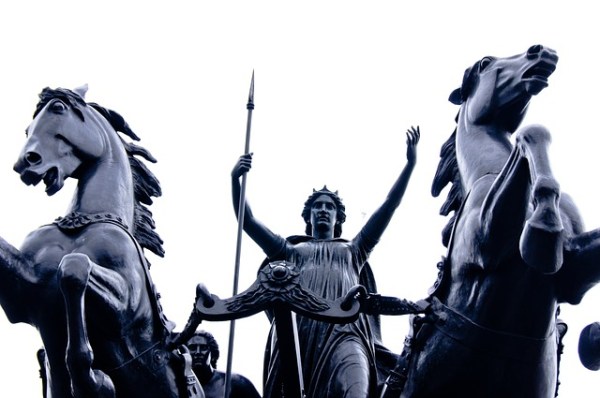
‘Londinium Falling’, one of fifteen stories, in Postcards from London by Tim Walker, is set in the year 64 when the young town suffered its first calamity – Boudicca’s Iceni army attacked a small Roman garrison and overran the town, massacring those within and burning down the buildings. This much is history. Tim’s story imagines that fateful day through the eyes of two world-weary legionaries, Marcellus and Septimus, who must fight for their lives against the screaming blue-painted, blood-thirsty warriors pouring over their flimsy earth bank defences…

The dockside was a mass of jostling and shouting townsfolk – sailors and slaves were carrying a variety of imperial objects aboard three galleys, and lesser traders filling a dozen or so small boats with people and supplies.

“Watch where you’re going!” A citizen carried on a sedan chair whacked Hywel on the head with a leather whip, causing him to stagger, as the jostling tide of humanity made their way to the row of waiting boats on the Quayside.

“Do not abuse my slave, sir!” Julia shouted above the din. “My husband is a legionary fighting for our safety.” She hugged her child tightly and glared at the fat, impassive Patrician.

Hywel turned and grinned his appreciation at his plucky mistress. “This way, my lady – Petronius the wine merchant has a boat. Your husband is a regular customer – he will help us. Let us make haste.” They battled through the anxious crowd as the distant sounds of battle grew increasingly louder.

Marcellus searched the crowd for Julia and Cato, but could not see them amongst the multitude of milling townsfolk and soldiers. He did see Governor Decianus and Centurion Maximius standing on the prow of a galley, the latter bellowing out orders for a defensive square. Legionaries with shields and weapons intact started to move towards the outer edges of the square and stand side-by-side, awaiting the barbarian onslaught.

Septimus grabbed Marcellus by the arm and pointed to a small boat already bobbing freely in the river. On it Julia and Cato were shouting and waving to them, their words snatched away by the breeze and hubbub. A broad smile cracked Marcellus’ cheeks as he waved back – relief was written on his blood-spattered face.

“Now we can fight barbarians,” he said, grinning at his friend. Septimus called his unit into a huddle and left them to go in search of a friendly sea captain. But no sooner was he gone than a boisterous optio commanded them to form up in the defensive wall. Marcellus duly complied with the rest of the unit, and they found themselves with members of the first cohort who had not yet faced the enemy – as they had been guarding the docks and both ends of the bridge.

“What’s it like?” one of them asked the cut, bleeding and battered unit.

Marcellus replied, “Imagine thousands of blue-painted screaming devils being chased through the Gates of Hades by the three-headed hound Cerberus. Look – here they come…!” He pointed with the tip of his gladius as the first group of warriors raced from the streets that fed into the open space before the docks, screaming and waving their bloody weapons. They stopped short of the wall of Roman shields and seemed to wait for a leader to come. They shouted obscenities and banged their swords, spears and axes against their round shields, and some threw the severed heads of soldiers at the Romans. The evacuation of non-combatants was swiftly completed and Maximius, from the safety of his galley, urged them to hold the line at all costs.

“General Paulinius is on his way!” Maximius shrieked, his words barely carrying above the racket to a doubtful Marcellus.

The warriors then quietened and parted to allow three chariots to enter from a side street. A tall proud woman with long flowing red hair and blue swirls on her cheeks, wearing a shining metal breastplate and clutching a spear, glared at the Roman Centurion. She urged her driver to ride between the two lines of opposing soldiers, periodically throwing heads over the Roman shield wall as she went. Marcellus gazed at her in awe, her authority over the seemingly wild rabble was undisputed. Some even bowed as she rode by. She lifted her spear again and screamed a command as her chariot reached the end of the line, and her faithful followers fell on the Roman shield wall with maddening ferocity.

Postcards from London is Tim Walker’s second collection of short stories and draws on the vivid history of the vibrant city of London where he has both worked and lived. Imagine Iron Age fishermen, open-mouthed to see Roman galleys rowed by slaves dropping anchor at their village on a river the Romans would name the Tamesis – at a place they would turn into the port and fortified town of Londinium.

This happened two thousand years ago and those Romans were the first of many men of vision who would come to shape the city we see today. London’s long and complex history almost defies imagination, but Tim has conjured citizens from many familiar eras, and some yet to be imagined.


Drink the Lethe

And I can’t speak out your name,
it is lidded, sealed, locked away.
You’re here, you’re there.
How can I know just where you are
and find you everywhere?
Reminded every day,
knowing that a chance to forget
would be met, should it be taken,
with regret.
Drink the Lethe, I don’t care,
plenty of other rivers know our names.

P. F. Marún Oxenford

Moonbeam Farquhar Metheringham IV’s review of ‘The Little Prince’ by Antoine de Saint-Exupéry

This is a story that hit me right between the eyes.

I always remember the first time I saw Mumsie crying. She was standing there with tears flowing from her eyes and holding a knife in her hand. At the time I was, mayhap, still a mere young teen but aware enough in the ways of the world to know that a weeping parent must mean an extreme of emotion and a knife gripped in one hand could only mean one thing. She was going to murder Daddy.

I ran into the room shrieking in my piping soprano voice (I was a late developer), begging her to put down the knife. She glared at me through red-rimmed eyes and stabbed the point into the chopping board.

“Oh for fuck’s sake Moons, I’m just chopping the sodding onions. Go and do something useful. Or do something – anything! Here!” and she grabbed a book from the shelf beside her and hurled it at me. The corner of the book hit me between the eyes causing a bruise that lasted several days and after I had redeemed it and found a solitary corner of the lounge, I read it.

So. My review.

This is a book written by a Frenchman who clearly should have been born English as it is the most translated book in the French language. Had he been born English it would have needed less translating.

The story is very sweet and cloying.

An airman crashes in the desert and for some unbeknownst reason meets a small boy who is suffering from delusions of grandeur. Instead of telling the clearly deranged infant to leave him alone, our hero befriends him and has to listen to a load of unbelievable tales about life on other planets.

There is a fox in it too.

I never understood the point of it.

Nil stars.

Moonbeam Farquhar Metheringham IV

Adoring Fans can join my Facebook Group.

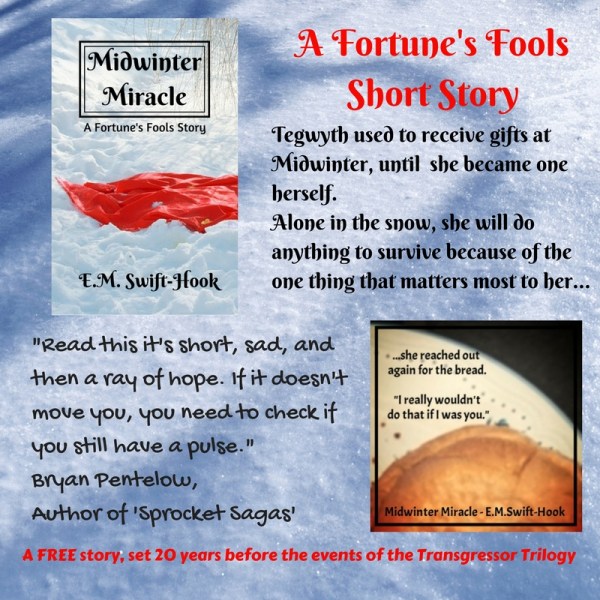
Tegwyth – from ‘Midwinter Miracle’

Midwinter Miracle

I.

It was Midwinter.

Tegwyth reminded herself of that. A time for celebrating that the longest season had finally turned on its pivot and the warmth of summer, though short-lived, would come again. A time for gifts to be given and feasts to be eaten. In past years she had been given gifts by the owner of the caravan – her owner – trinkets to wear, bangles for her wrists and ankles, a fine scarf to protect her hair and pull over her face, keeping the dust from her nose and mouth, as it was thrown up by the caravan on the road. She had been pampered and cosseted, well treated and cared for. She had even believed she was loved.

Then last Midwinter she had become a gift.

She had seen it coming from the moment his true-born child had started speaking venom – one who would take no competition for her father’s affections. And he, in his turn, adored her and indulged her. Then the boy-child Tegwyth carried was born to live no more than a few gasping breaths, like all his sons before. She had failed him.

So at Midwinter she had been given away. A gift to seal a trading pledge with a merchant from across the ocean – a merchant from this city, from Keran. The merchant had taken her into his house and then taken almost all she cared about from her – even her hope. But when he threatened to take and sell the most precious thing in her life, she had risked everything and run away. It had been her Midwinter gift to herself.

So yes, Midwinter was about gifts and feasting, but sometimes, maybe, you had to take the gifts and help yourself to the food.

It sat on the table beside a smeared empty bowl with a lingering savoury smell of soup. Someone had bought it, eaten their fill and left half the loaf. Whoever it was did not want the bread and it had already been paid for, so it could not really be considered theft.

She had first seen it through the small window, as she stood, shivering, in the frozen white outside. Somebody had wiped away the condensation of the warmth within so they could look out, which had granted her a half-glimpse inside the tavern. That had been enough. Following a group of wealthy men and their whores through the briefly open door, then shrinking into the shadows to disguise the quality of her dress and the thin felt cloak that had been worn through in patches.

The loaf still sat unguarded. The boy clearing the tables did not seem to have noticed it yet. He was at the far side of the room, dodging between the patrons with their fine and fancy faces, plump from good eating. He ducked, avoiding a cuff aimed at his ear, as he picked up a jug someone had not yet deemed empty.

The loaf looked bigger than it had through the window. Tegwyth’s stomach called out to it and she was grateful for the sounds of raucous cheer. Without them, the man standing with his back to her, close by the fire, might have heard. He was tall and even from behind she could see the wider whiskers of his beard as they spread from his chin.

She knew who he was, of course, all of Keran had heard of him. They called him Drum. He was someone special here and his arrival the previous day had been talked of everywhere as she hunted for food. Not many sons of Temsevar, as she knew well, made their way to other worlds and even fewer of those who did ever came back as he did. Even here in Keran, where the twin domes of the spaceport humped high with snow dominated the city, it still seemed strange beyond imagining for Tegwyth. She struggled to believe that anyone could come from worlds beyond the stars.

Her eyes moved back to the loaf which seemed so far away – as if, it too, sat on another world. Beside it, cast aside onto the stool and partly pooling its fabric over the table, was an odd, sleeved garment that might be some kind of coat. It was the colour of freshly shed blood but had a sheen in its fabric which the flickering firelight caught and played with. She had seen the bearded man wearing it out in the snow on his way here. It must be warm to wear as he had needed no cloak. Even above the gripe of her stomach for food, she felt a sudden desire for the coat and the warmth it could give.

Midwinter Miracle is available as a free short if you request a copy in December or can be read online.

Here and There

This is the place.
Here.
Once it was full.
Life.
People warmed, working.
Here.


This was the place.
There.
Empty and bleak.
Dead.
No one left, useless.
There.

Monday Meme – Blue Planet


Once upon a time, the world was covered in water, and the overlord sat on a smooth rock overlooking his domain. All was well and he smiled into the blueness of the sky. The merpeople sang and the fishes swam, and every creature lived in its appointed place. But then a strange thing began to happen, dry green pieces could be seen poking out of the oceans, and creatures that should have been swimming began crawling in the greensward and flying in the clouded blue. The overlord looked up towards the heavens and cried to the creators for help, but no help came.

Those who made the blue planet had turned their attentions elsewhere and the green and the brown slowly took over the blue and the silver.

Once upon a time, man crawled out of the water and set his foot on duty land, thinking himself master of all he surveyed. But the world took against him as he plundered and purloined her treasure. The waters started to rise and man cried to the creators for help. But no help came.

The blue and silver slowly took over the brown and green and the overlord’s rocky throne slowly rose from the waves. The merpeople sang and the fishes swam, and once again every creature lived in its appointed place…


©️ Jane Jago

Sunday Serial – IX

What with laughter and the prospect of breakfast, when the waitress returned with their drinks, plus a basket of bread and two racks of toast, Bill had recovered his equilibrium sufficiently to thank her politely and discuss the merits of various sorts of jam for his toast. When they had given their orders, Rod beckoned the waitress and whispered something in her ear. She nodded vigorously and he grinned.

“What was that all about?” Anna laughed.

“Special treat for the little man.”

“What will that be?” Bill wondered.

“Wait and see…”

Bill waited, and crowed with delight when the waitress set a small dish of clotted cream beside his bowl of cereal. He beamed from ear to ear.

“Thank you. You are a very kind uncle. That is my specially favourite thing.”

Rod swallowed an obvious lump in his throat.

“I know. Enjoy,” he croaked.

Once breakfast had reached the toast and jam stage, Anna smiled at Bill.

“I think you should tell Sam all about your family. So he can get them straight in his head before he meets them.”

“Yes. I should. If I don’t he may be so surprised by the twins that he runs away. I wouldn’t like that. I’ll start with Daddy. He is Uncle Rod’s twin brother, but he isn’t nearly so big. Grandma Cracksman says he is the runt of the litter. I think that’s rude, but Daddy laughs. He says he may not have the family brawn, but he did get all the brains. Is that right Anna?”

“It is, except that the smallness is relative. Jim’s a chunky six five as opposed to a rangy whatever Rod is.”

“Six nine. But we’re interrupting Bill.”

“Mummy next. She’s beautiful. Blonde and cuddly, and with the biggest blue eyes in the world. She sings when she’s happy and hearing her sing makes us happy too.”

Rod patted his head.

“She’s a belter and no mistake. But she’s a big girl with it, and there’s nobody can cuss a blue streak like Patsy Cracksman.”

Bill laughed.

“You are right. She does swear beautifully. My brother Jaimie is next oldest. He’s fourteen. I like him a lot, because he is patient and explains things when I don’t understand. He is very clever with computers. Just like Daddy. Then comes the twins. They are twelve-and-bit, and they are very difficult to explain. Sometimes I like them and other times I don’t. They are quite rough and quick-tempered, and they only really like each other and Mummy. Their proper names are Matthias and Cyrano, but mostly people call them Matt and Cy, or Twins. Except for Anna who calls them Dickhead and Shitface.”

Anna coloured.

“To my eternal shame. I called them it once when they were about seven and I was at my wits’ end. Since when they have tormented me by refusing to answer to anything else.”

Rod grinned.

“I call them ‘you pair of fuckers’, so I got no moral high ground there. They are just like me and Jim were at that age. Intolerable. Inseparable. They will be easier to handle, and easier to prise apart, when sex rears its ugly head.”

Bill looked from Anna to Rod, then shook his head wisely.

“If grown ups can’t deal with them, it’s no wonder me and Charlie mostly avoid them. Charlie is my little brother. He’s only five, but he’s very, very smart. He learns things so fast it frightens some of his teachers. But he is kindhearted and helps the others in his class when they don’t understand their work. His class teacher told Daddy that he was already better at teaching than anybody else in our school. But the head teacher don’t like it that he is so smart. He don’t care, though. The only reason he don’t tell her to feck off is that he promised Daddy he wouldn’t. Then there’s Gandalf and Eller, who are Mummy’s dogs, Daddy’s dog Benni, the cat who is just called Cat, and Jamie’s parrot Cap’n Flint. That’s all of us.”

Bill sat back in his chair, with the air of one who has done a good job. Rod clapped his hands softly.

“A masterful dissertation, young Cracksman. Now. Are we all finished. I’ll get the bill…”

He frowned at Anna who was about to argue.

“I’ll get the bill. Everyone else should use the toilets if they need.”

Sam and Billy ambled off the the gents and Anna smiled at Rod.

“It was a good idea to get the wee man talking about his family.”

“Yeah. I thought so. Thought it would help to ground him. Now where’s that waitress?”

Anna went slowly to the ladies, pondering on how easy it was to underestimate Rod. Big, in his case, certainly didn’t denote slow or stupid.


When she returned, the waitress was just giving Rod a receipt. He grinned at her and popped something into her apron pocket.

“And that’s just for you. I’ve added ten per cent to the bill for everyone else.”

The young girl pinked prettily.

“Thank you.”

Bill patted her.

“Don’t let him ‘barrass you. He means to be kind.

The girl crouched down impulsively and kissed Bill’s smooth cheek.

“If all our guests were as nice as you and your family.”

So they arrived at the camper laughing as Rod offered to fight Bill for the waitress’ favours. Bonnie jumped out to greet them.

“There’s a dog exercise field behind the green gate, and Bonnie would love a run before we set out. Will you take her Bill?”

“Oh yes. My legs would like to run too. But I’m a bit too scared to go on my own.”

“That’s OK,” Sam smiled down at him, “I’d like a run. Rod? Anna?”

Rod nodded, but Anna held up her hands.

“You lot go along. I’ll get the camper ready for travel.’


Jane Jago

Start a Blog at WordPress.com.

Up ↑