Coffee Break Read: Londinium Falling – Tim Walker

‘Londinium Falling’, one of fifteen stories, in Postcards from London by Tim Walker, is set in the year 64 when the young town suffered its first calamity – Boudicca’s Iceni army attacked a small Roman garrison and overran the town, massacring those within and burning down the buildings. This much is history. Tim’s story imagines that fateful day through the eyes of two world-weary legionaries, Marcellus and Septimus, who must fight for their lives against the screaming blue-painted, blood-thirsty warriors pouring over their flimsy earth bank defences…

The dockside was a mass of jostling and shouting townsfolk – sailors and slaves were carrying a variety of imperial objects aboard three galleys, and lesser traders filling a dozen or so small boats with people and supplies.

“Watch where you’re going!” A citizen carried on a sedan chair whacked Hywel on the head with a leather whip, causing him to stagger, as the jostling tide of humanity made their way to the row of waiting boats on the Quayside.

“Do not abuse my slave, sir!” Julia shouted above the din. “My husband is a legionary fighting for our safety.” She hugged her child tightly and glared at the fat, impassive Patrician.

Hywel turned and grinned his appreciation at his plucky mistress. “This way, my lady – Petronius the wine merchant has a boat. Your husband is a regular customer – he will help us. Let us make haste.” They battled through the anxious crowd as the distant sounds of battle grew increasingly louder.

Marcellus searched the crowd for Julia and Cato, but could not see them amongst the multitude of milling townsfolk and soldiers. He did see Governor Decianus and Centurion Maximius standing on the prow of a galley, the latter bellowing out orders for a defensive square. Legionaries with shields and weapons intact started to move towards the outer edges of the square and stand side-by-side, awaiting the barbarian onslaught.

Septimus grabbed Marcellus by the arm and pointed to a small boat already bobbing freely in the river. On it Julia and Cato were shouting and waving to them, their words snatched away by the breeze and hubbub. A broad smile cracked Marcellus’ cheeks as he waved back – relief was written on his blood-spattered face.

“Now we can fight barbarians,” he said, grinning at his friend. Septimus called his unit into a huddle and left them to go in search of a friendly sea captain. But no sooner was he gone than a boisterous optio commanded them to form up in the defensive wall. Marcellus duly complied with the rest of the unit, and they found themselves with members of the first cohort who had not yet faced the enemy – as they had been guarding the docks and both ends of the bridge.

“What’s it like?” one of them asked the cut, bleeding and battered unit.

Marcellus replied, “Imagine thousands of blue-painted screaming devils being chased through the Gates of Hades by the three-headed hound Cerberus. Look – here they come…!” He pointed with the tip of his gladius as the first group of warriors raced from the streets that fed into the open space before the docks, screaming and waving their bloody weapons. They stopped short of the wall of Roman shields and seemed to wait for a leader to come. They shouted obscenities and banged their swords, spears and axes against their round shields, and some threw the severed heads of soldiers at the Romans. The evacuation of non-combatants was swiftly completed and Maximius, from the safety of his galley, urged them to hold the line at all costs.

“General Paulinius is on his way!” Maximius shrieked, his words barely carrying above the racket to a doubtful Marcellus.

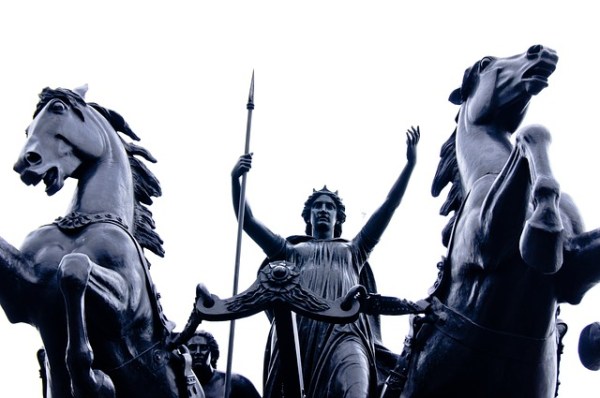
The warriors then quietened and parted to allow three chariots to enter from a side street. A tall proud woman with long flowing red hair and blue swirls on her cheeks, wearing a shining metal breastplate and clutching a spear, glared at the Roman Centurion. She urged her driver to ride between the two lines of opposing soldiers, periodically throwing heads over the Roman shield wall as she went. Marcellus gazed at her in awe, her authority over the seemingly wild rabble was undisputed. Some even bowed as she rode by. She lifted her spear again and screamed a command as her chariot reached the end of the line, and her faithful followers fell on the Roman shield wall with maddening ferocity.

Postcards from London is Tim Walker’s second collection of short stories and draws on the vivid history of the vibrant city of London where he has both worked and lived. Imagine Iron Age fishermen, open-mouthed to see Roman galleys rowed by slaves dropping anchor at their village on a river the Romans would name the Tamesis – at a place they would turn into the port and fortified town of Londinium.

This happened two thousand years ago and those Romans were the first of many men of vision who would come to shape the city we see today. London’s long and complex history almost defies imagination, but Tim has conjured citizens from many familiar eras, and some yet to be imagined.

 

Drink the Lethe

And I can’t speak out your name,
it is lidded, sealed, locked away.
You’re here, you’re there.
How can I know just where you are
and find you everywhere?
Reminded every day,
knowing that a chance to forget
would be met, should it be taken,
with regret.
Drink the Lethe, I don’t care,
plenty of other rivers know our names.

P. F. Marún Oxenford

Moonbeam Farquhar Metheringham IV’s review of ‘The Little Prince’ by Antoine de Saint-Exupéry

This is a story that hit me right between the eyes.

I always remember the first time I saw Mumsie crying. She was standing there with tears flowing from her eyes and holding a knife in her hand. At the time I was, mayhap, still a mere young teen but aware enough in the ways of the world to know that a weeping parent must mean an extreme of emotion and a knife gripped in one hand could only mean one thing. She was going to murder Daddy.

I ran into the room shrieking in my piping soprano voice (I was a late developer), begging her to put down the knife. She glared at me through red-rimmed eyes and stabbed the point into the chopping board.

“Oh for fuck’s sake Moons, I’m just chopping the sodding onions. Go and do something useful. Or do something – anything! Here!” and she grabbed a book from the shelf beside her and hurled it at me. The corner of the book hit me between the eyes causing a bruise that lasted several days and after I had redeemed it and found a solitary corner of the lounge, I read it.

So. My review.

This is a book written by a Frenchman who clearly should have been born English as it is the most translated book in the French language. Had he been born English it would have needed less translating.

The story is very sweet and cloying.

An airman crashes in the desert and for some unbeknownst reason meets a small boy who is suffering from delusions of grandeur. Instead of telling the clearly deranged infant to leave him alone, our hero befriends him and has to listen to a load of unbelievable tales about life on other planets.

There is a fox in it too.

I never understood the point of it.

Nil stars.

Moonbeam Farquhar Metheringham IV

Adoring Fans can join my Facebook Group.

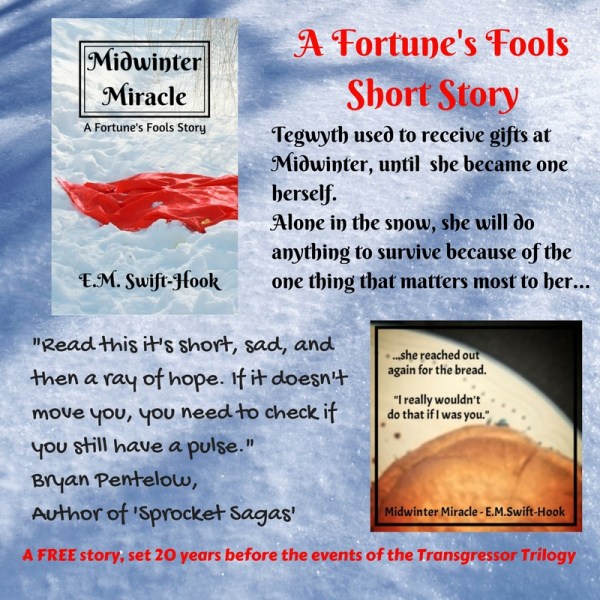
Tegwyth – from ‘Midwinter Miracle’

Midwinter Miracle

I.

It was Midwinter.

Tegwyth reminded herself of that. A time for celebrating that the longest season had finally turned on its pivot and the warmth of summer, though short-lived, would come again. A time for gifts to be given and feasts to be eaten. In past years she had been given gifts by the owner of the caravan – her owner – trinkets to wear, bangles for her wrists and ankles, a fine scarf to protect her hair and pull over her face, keeping the dust from her nose and mouth, as it was thrown up by the caravan on the road. She had been pampered and cosseted, well treated and cared for. She had even believed she was loved.

Then last Midwinter she had become a gift.

She had seen it coming from the moment his true-born child had started speaking venom – one who would take no competition for her father’s affections. And he, in his turn, adored her and indulged her. Then the boy-child Tegwyth carried was born to live no more than a few gasping breaths, like all his sons before. She had failed him.

So at Midwinter she had been given away. A gift to seal a trading pledge with a merchant from across the ocean – a merchant from this city, from Keran. The merchant had taken her into his house and then taken almost all she cared about from her – even her hope. But when he threatened to take and sell the most precious thing in her life, she had risked everything and run away. It had been her Midwinter gift to herself.

So yes, Midwinter was about gifts and feasting, but sometimes, maybe, you had to take the gifts and help yourself to the food.

It sat on the table beside a smeared empty bowl with a lingering savoury smell of soup. Someone had bought it, eaten their fill and left half the loaf. Whoever it was did not want the bread and it had already been paid for, so it could not really be considered theft.

She had first seen it through the small window, as she stood, shivering, in the frozen white outside. Somebody had wiped away the condensation of the warmth within so they could look out, which had granted her a half-glimpse inside the tavern. That had been enough. Following a group of wealthy men and their whores through the briefly open door, then shrinking into the shadows to disguise the quality of her dress and the thin felt cloak that had been worn through in patches.

The loaf still sat unguarded. The boy clearing the tables did not seem to have noticed it yet. He was at the far side of the room, dodging between the patrons with their fine and fancy faces, plump from good eating. He ducked, avoiding a cuff aimed at his ear, as he picked up a jug someone had not yet deemed empty.

The loaf looked bigger than it had through the window. Tegwyth’s stomach called out to it and she was grateful for the sounds of raucous cheer. Without them, the man standing with his back to her, close by the fire, might have heard. He was tall and even from behind she could see the wider whiskers of his beard as they spread from his chin.

She knew who he was, of course, all of Keran had heard of him. They called him Drum. He was someone special here and his arrival the previous day had been talked of everywhere as she hunted for food. Not many sons of Temsevar, as she knew well, made their way to other worlds and even fewer of those who did ever came back as he did. Even here in Keran, where the twin domes of the spaceport humped high with snow dominated the city, it still seemed strange beyond imagining for Tegwyth. She struggled to believe that anyone could come from worlds beyond the stars.

Her eyes moved back to the loaf which seemed so far away – as if, it too, sat on another world. Beside it, cast aside onto the stool and partly pooling its fabric over the table, was an odd, sleeved garment that might be some kind of coat. It was the colour of freshly shed blood but had a sheen in its fabric which the flickering firelight caught and played with. She had seen the bearded man wearing it out in the snow on his way here. It must be warm to wear as he had needed no cloak. Even above the gripe of her stomach for food, she felt a sudden desire for the coat and the warmth it could give.

Midwinter Miracle is available as a free short if you request a copy in December or can be read online.

Here and There

This is the place.
Here.
Once it was full.
Life.
People warmed, working.
Here.


This was the place.
There.
Empty and bleak.
Dead.
No one left, useless.
There.

Monday Meme – Blue Planet


Once upon a time, the world was covered in water, and the overlord sat on a smooth rock overlooking his domain. All was well and he smiled into the blueness of the sky. The merpeople sang and the fishes swam, and every creature lived in its appointed place. But then a strange thing began to happen, dry green pieces could be seen poking out of the oceans, and creatures that should have been swimming began crawling in the greensward and flying in the clouded blue. The overlord looked up towards the heavens and cried to the creators for help, but no help came.

Those who made the blue planet had turned their attentions elsewhere and the green and the brown slowly took over the blue and the silver.

Once upon a time, man crawled out of the water and set his foot on duty land, thinking himself master of all he surveyed. But the world took against him as he plundered and purloined her treasure. The waters started to rise and man cried to the creators for help. But no help came.

The blue and silver slowly took over the brown and green and the overlord’s rocky throne slowly rose from the waves. The merpeople sang and the fishes swam, and once again every creature lived in its appointed place…


©️ Jane Jago

Sunday Serial – IX

What with laughter and the prospect of breakfast, when the waitress returned with their drinks, plus a basket of bread and two racks of toast, Bill had recovered his equilibrium sufficiently to thank her politely and discuss the merits of various sorts of jam for his toast. When they had given their orders, Rod beckoned the waitress and whispered something in her ear. She nodded vigorously and he grinned.

“What was that all about?” Anna laughed.

“Special treat for the little man.”

“What will that be?” Bill wondered.

“Wait and see…”

Bill waited, and crowed with delight when the waitress set a small dish of clotted cream beside his bowl of cereal. He beamed from ear to ear.

“Thank you. You are a very kind uncle. That is my specially favourite thing.”

Rod swallowed an obvious lump in his throat.

“I know. Enjoy,” he croaked.

Once breakfast had reached the toast and jam stage, Anna smiled at Bill.

“I think you should tell Sam all about your family. So he can get them straight in his head before he meets them.”

“Yes. I should. If I don’t he may be so surprised by the twins that he runs away. I wouldn’t like that. I’ll start with Daddy. He is Uncle Rod’s twin brother, but he isn’t nearly so big. Grandma Cracksman says he is the runt of the litter. I think that’s rude, but Daddy laughs. He says he may not have the family brawn, but he did get all the brains. Is that right Anna?”

“It is, except that the smallness is relative. Jim’s a chunky six five as opposed to a rangy whatever Rod is.”

“Six nine. But we’re interrupting Bill.”

“Mummy next. She’s beautiful. Blonde and cuddly, and with the biggest blue eyes in the world. She sings when she’s happy and hearing her sing makes us happy too.”

Rod patted his head.

“She’s a belter and no mistake. But she’s a big girl with it, and there’s nobody can cuss a blue streak like Patsy Cracksman.”

Bill laughed.

“You are right. She does swear beautifully. My brother Jaimie is next oldest. He’s fourteen. I like him a lot, because he is patient and explains things when I don’t understand. He is very clever with computers. Just like Daddy. Then comes the twins. They are twelve-and-bit, and they are very difficult to explain. Sometimes I like them and other times I don’t. They are quite rough and quick-tempered, and they only really like each other and Mummy. Their proper names are Matthias and Cyrano, but mostly people call them Matt and Cy, or Twins. Except for Anna who calls them Dickhead and Shitface.”

Anna coloured.

“To my eternal shame. I called them it once when they were about seven and I was at my wits’ end. Since when they have tormented me by refusing to answer to anything else.”

Rod grinned.

“I call them ‘you pair of fuckers’, so I got no moral high ground there. They are just like me and Jim were at that age. Intolerable. Inseparable. They will be easier to handle, and easier to prise apart, when sex rears its ugly head.”

Bill looked from Anna to Rod, then shook his head wisely.

“If grown ups can’t deal with them, it’s no wonder me and Charlie mostly avoid them. Charlie is my little brother. He’s only five, but he’s very, very smart. He learns things so fast it frightens some of his teachers. But he is kindhearted and helps the others in his class when they don’t understand their work. His class teacher told Daddy that he was already better at teaching than anybody else in our school. But the head teacher don’t like it that he is so smart. He don’t care, though. The only reason he don’t tell her to feck off is that he promised Daddy he wouldn’t. Then there’s Gandalf and Eller, who are Mummy’s dogs, Daddy’s dog Benni, the cat who is just called Cat, and Jamie’s parrot Cap’n Flint. That’s all of us.”

Bill sat back in his chair, with the air of one who has done a good job. Rod clapped his hands softly.

“A masterful dissertation, young Cracksman. Now. Are we all finished. I’ll get the bill…”

He frowned at Anna who was about to argue.

“I’ll get the bill. Everyone else should use the toilets if they need.”

Sam and Billy ambled off the the gents and Anna smiled at Rod.

“It was a good idea to get the wee man talking about his family.”

“Yeah. I thought so. Thought it would help to ground him. Now where’s that waitress?”

Anna went slowly to the ladies, pondering on how easy it was to underestimate Rod. Big, in his case, certainly didn’t denote slow or stupid.


When she returned, the waitress was just giving Rod a receipt. He grinned at her and popped something into her apron pocket.

“And that’s just for you. I’ve added ten per cent to the bill for everyone else.”

The young girl pinked prettily.

“Thank you.”

Bill patted her.

“Don’t let him ‘barrass you. He means to be kind.

The girl crouched down impulsively and kissed Bill’s smooth cheek.

“If all our guests were as nice as you and your family.”

So they arrived at the camper laughing as Rod offered to fight Bill for the waitress’ favours. Bonnie jumped out to greet them.

“There’s a dog exercise field behind the green gate, and Bonnie would love a run before we set out. Will you take her Bill?”

“Oh yes. My legs would like to run too. But I’m a bit too scared to go on my own.”

“That’s OK,” Sam smiled down at him, “I’d like a run. Rod? Anna?”

Rod nodded, but Anna held up her hands.

“You lot go along. I’ll get the camper ready for travel.’


Jane Jago

Evidence of Sorrow

The evidence of grief
And the motions of sorrow
Some that we learn
And some we just borrow
The solitary figure
Dry eyed by the grave
Whose hurt runs too deep
For convention to brave
Who stands thus erect
Drawing scarcely a breath
Feels the hard scraping pain
Of a love killed by death
Those who say cold
Have not looked in those eyes
It is not just a loved one
But I who have died

©️ jane jago 2017

Weekend Wind Down – Dying on the Tide

From 'Dying on the Tide' one of the bonus short stories included in 'The First Dai and Julia Omnibus'

It was a two-hour drive to Virconium, given a speedy vehicle and a reliable driver. Having both, they arrived without incident. The city was gearing up for next month’s Saturnalia with bright lights and sparkly tinsel in every shop window to lure in gift-buyers. Julia felt an odd pang of nostalgia as she caught sight of a display of sigillaria in one. There were candles moulded or carved into fantastic and beautiful wax sculptures, beside a shelf of grotesque and amusing ones. She wondered how it would be to spend her first Saturnalia away from Rome.

The navi system took them straight to the dance studio, where Julia followed Dai and Bryn as they made their way to the reception desk in a cool quiet portico. The elaborately coiffed young man behind the white and gold edifice recoiled visibly.

“Members only,” he snapped.

Bryn stepped forward.

“The Submagistratus wants a word with Bont.”

The receptionist opened and closed his mouth a few times, but no sound emerged.

“Sometime this week, sonny”

“Not possible. Ulysses is busy right now.”

“Well un-busy him.”

“I don’t think I can…”

Bryn smiled and leaned over the desk, cracking his knuckles. The receptionist swallowed audibly, then he thumbed a button.

“Ulysses Bont to reception. Immediately please.”

Bryn rewarded him with a wolfish grin.“Now you’re being sensible. Got somewhere we can talk uninterrupted?”


They were soon ensconced in a pleasant room, which Julia was delighted to find came complete with beverages and cake. It wasn’t long before they were joined by a lean man wearing a sardonic expression.

“You wanted me, dominus?” he said a waspish bite to his tone.

Dai looked him up and down slowly.

“I think wanted is an exaggeration.”

Bont coloured, but Julia could see he wasn’t brave enough to argue with a man whose blue eyes were as bleak as a winter morning. Bont shut his mouth and cast down his gaze.

“Better. Now. Talk to me about Tales from the Mabinogion.”

“What?” Bont looked up in surprise. “The dance troupe?”

“Yes.”

“We were contracted for a three-month school tour. Then disbanded.”

He met Dai’s stare defiantly for a moment, then looked at Julia. She schooled her expression to stone. Something in her face seemed to get to him, though and he sighed. “Okay, it was more than a bit odd. We were paid well over the going rate and our paymasters were a bit creepy. Too interested in kids. Always girls and always the petite ones. Not that I ever saw them actually do anything, I’d have reported them if they had.” he broke off for a moment as if thinking about what had happened. “You have to understand, they really weren’t the sort of people you question. But…”

“But indeed. Do you have any names?”

“There were two of them, a couple of men, called themselves Smith. Can I ask what you think they have done?”

“Eleven of those girls have gone missing.”

“Oh no. Please, no.” Bont looked truly sick. “Look. I don’t know much that could help you, I really wish I did. That’s – just horrible.” He broke off shaking his head as if trying to deny it. Then he looked up directly at Dai. “Except that there’s this female dancer, I never liked her. Her name is Katya Czesny, she was right in with the Smiths. And she is still working In Viriconium.”

“Where?”

“A nightspot. The Scarlet Letter. She’s cage dancing now. Calls herself Lubricia.”

Julia spoke for the first time.

“Thank you,” she said softly.

The Dai and Julia Mysteries are written by Jane Jago and E.M. Swift-Hook

The Thinking Quill

Dear Reader Who Writes,

One cannot help but feel that one scarcely needs to trouble oneself with an introduction. The trademark quill? The eloquent and sophisticated writing style? It could be none other than Moonbeam Farquhar Metheringham IV – acclaimed and admired author of “Fatswhistle and Buchtooth” whose fantastical and fortuitous adventures through the megaplex-multiverse have been steady in the Amazon charts as Bestseller One – in a – Million for over a year.

And, as Mummy so eloquently put it, “Moony, you little tosspot, you have been  writing that freaking crap for so long now – if the poor unfortunate sods who read it don’t know your name by this time they ain’t never gonna learn.” As I recall it, she then spat reflectively into the fire and a gobbet of saliva and mucus bubbled gently on the artificial logs.

And so to our next lesson. Sit up straight and pay attention. There may be an examination later.

Lesson Thirteen: The Write Price

Yes my panting little followers, let us for just one moment pretend that you have come so far as to be able to offer a book of your own creation up for the delectation of that cruel and capricious bitch that is the reading public. You have crossed every eye and dotted every tee, you have edited and subedited, you have begged the opinion of many readers (none of whom will agree on any point, leaving you to either start again from scratch or ignore them all) and placed your precious manuscript into the hands of the holy angel Kindle. All is going swimmingly, and then you are asked what price you wish to place upon this darling offspring of your imagination. Your mind will be in turmoil. What should I do? The question reverberating around the cold, damp, muddy canyons of your simple little psyche.

Is it wise to charge the mean 99p/99c? For those whose virginity had yet to be breached in this area of life, this Is the smallest moiety Dame Kindle allows her charges to place on their literary efforts. Many so-called wise heads will tell you that this is the course of wisdom and the road by which your little effort may reach the hearts and minds of the greatest number of possible new lovers of your precious prose. These prophets of doom will say unto you that you are a new author and you should be properly humble and have low expectations of the sales and monetary gain to be expected from a self-published novel from the pen of an unknown.

I say. Fie upon them. And again fie upon them.

Let not such smallness ever press its skinny little fingers into the soft pink marshmallowiness of your flesh. Let not such paucity of ambition sully the pristine pathways in your little head.

Never price a book below Ten Pounds Sterling. Whatever that may be in colonial currencies (eleven euros or thirteen dollars, Mummy tells me). Whether she be correct or as far off the beam as the mad old bat usually is matters not here. We are speaking of principle here, of the sale of our heart’s’ blood, of the prostitution of the children of our mind. Therefore let us at least ask a fair price for our endeavours. Ten Pounds Sterling, and not a penny less…

And while the rightness and wrongness of pricing is on my mind there is one other thing we must discuss. The promotion. The book sale. The freebie. The so-called  holy grail of marketing, supposed to garner you sales ranking and reviews. Well it’s just so much pish and tush. I am here to tell you not to bother. One, having once been inveigled into allowing one’s masterpiece to be offered free of charge for a whole week, knows of what one speaks. And how many downloads did that garner? And how many reviews followed? One download (which turned out to be Mummy who was too stingy to buy it before). I repeat One Download And No Reviews.

So don’t do it. Price in a way that reflects the love and inspiration you have put in your magnum opus – and stick with it.

Until next. Remember to wash behind your ears, and ecrit  bon

Moonbeam Farquhar Metheringham IV

Adoring Fans can join my Facebook Group.

Start a Blog at WordPress.com.

Up ↑